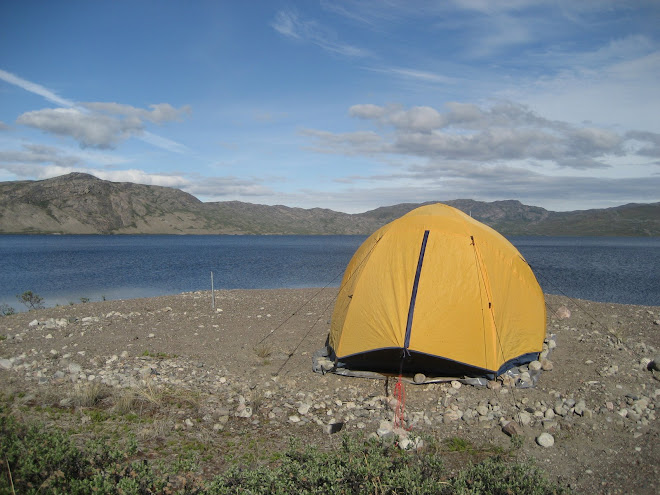
On Saturday, Sparky loaded up the old Ford 4x4 and drove a group of us up to the edge of the ice cap. There is a long, sandy road that winds out of Kangerlussuaq along the Watson river to where the rock and heath end and the ice begins. A few miles before one parks, abruptly against the wall of seracs, the road turns into a jeep track. Muddied and rutted, steep and boggy, any attempt to drive out here is certainly not for the unordained - offroader; it is an experiment in the physics of torsional chassis dynamics and luck. We made it to the Russel's glacier just as the sun erupted from the overcast sky.
Covering the rock is a soil that is only about a foot deep. In this soil grows a variety of heaths and shrubs, flowers, sedges, grasses, lichens, moss, fungi, and the rhododendron, Lapponica. The tiny purple trusses of this northern most rhododendron are just beginning to open, some in full display, a bright, transparent purple flower smaller than the thumb.
All around in the air, birds chirped, flies buzzed, wind tickled the senses. Beside us, leaned the glacier's exposed, decaying, fragmented edge. Lacerated shards of blue so deep and clear and dull and scrathced and broken, yet sharp; threatening, beckoning.
From underneath roared water. It came from hollowed caves. It poured out from crevasses over quartz veined gneiss.It tumbled gray with silt, turquoise with light. We all stood waiting for a piece of the glacier to release itself to time aided by gravity, undermined by these waters, but none were ready to fall.
We hiked along the edge over barren rock towards a lake as silent and calm as a secret.
Steve and I had brought along our bikes. WE left the group of glaciologists and hydrologists that Sparky had brought out for the day, and headed back the 30 km to town. We passed a place in the road that seemed otherworldly. Rock and glacier, storm building sky, and an earth reveling in the glories of spring. Dust stirred through the air. No noise but the wind, creaking ice. Cairns built long ago, rumored burial grounds, lakes resistive to breezes, reflecting stone and cloud and blue and flashes of the sun.
Along the way we met a pair of travelers also out on bikes. A man an women. She from Denmark, he from Kurdistan. He had been rented the most pitiful bike I had ever seen go so far away from any help. The rim had been split, the rubber on the tire was lacerated and cut and broken down by UV rays. The tube had been punctured and they had no repair kit.
Luckily we had our bike tools and tube patches. We also had a first aid kit. The man with the flat had some string. I used 2 steri strips to hold the tape inside the rim together to keep the spoke screw heads from poking the tube. Steve patched the tire. WE cut strips from a felt cloth to line the inside of the tire, further protecting the tube, then I lashed string around the worst of the tire to give it new tread. I had taken 2 bike pumps for some readon this day, so we could afford to lend them one.
Later that night, back in Kangerlussuaq, they returned the pump to us. They had been able to ride out the whole way!
Monday, May 26, 2008


Wednesday, May 21, 2008
Monday morning we awoke to rain. Tuesday wet snow; the flakes so big and heavy, they fell to the mud in clumps. Today the sky was blown to pieces and the wind, from off of the North Atlantic, piercing.
Last night I ran east along the river on the low road out past the golf course. The roads are all sand and have a few wash outs which I leap across carefully. I look up into the head of the valley at the lumpy hills that stand alone. They are similar to pingos but are not pingos. Pingos are solitary hills of ice pushed up by the pressures of permafrost, covered by earth.
The cloud's shadows fell across the rolling earth darkening the foreground, illuminating the distance. The ice cap gave off a silty gray sheen like a well used aluminum pan.
The wind is at my back the whole way out,I feel the landscape belonging. When I turn to run back towards town I face into 15 knots of air and my heart rate exceeds my pace. Still I follow the river to the fjord.
The trash in Kangerlussuaq all gets burned. There is no recycling except for the hard plastic soda bottles and the small, stocky necked glass bottles. Everything else gets hauled up to the burn pit and lit. When it has become ash it is pushed down a bank where it waits for the waters from the river and the fjord.
Meanwhile, dumpsters must wait for the man who drives the truck to come and haul them away. Our's was full of trash sent out from Summit. One by one the ravens congregated on the top of the dumpster attracted by the freshly thawed food waste. I counted 28 birds, each one larger than a Schnauzer, ripping and tearing into trash; no comparison to the finches and juncos we left swinging in the cherry tree from a liter sized feeder.
Late Tuesday afternoon Ole arrived with his big diamond earring and his safety green city shop suit,made in Denmark. The ravens followed the truck up the hill.
The post office has cut back on its hours. They are now open from 9-10 in the morning. 1-3 in the afternoon.
I went to the warehouse that supplies the only grocery store by the same name; Pilersuissoq. Another man with a Danish name and a cigarette stood on top of a small electric fork lift and took care of my order. There was some confusion translating pounds into kilograms and deciding which bunch of toilet paper to buy, but after some mildly painful paperwork for Jen's, I left with all of the flour and coffee and T.P. Summit had requested for the week.
On the other side of town at Air Greenland the cargo freight service, Tim leafed through an enormous volume of paperwork with the quickness of a dog scratching up a bone as I peered over his shoulder trying to avoid the cigarette smoke, doing my best to decipher from the Danish and Greenlandic type, what might be the missing box I was hoping to find. Tim made a couple phone calls, first to Kulusuk on the east coast, then to Tasilaq, also on the east coast, and after hanging up and taking a sip of coffee said with a smile, "it is in Tasaliq".
Phone conferences with 5 or 6 people, some in Denver, some at Summit, some in NY help us all to feel just a little less confused about the next flight week. Afterwards I return to our warehouse to count life vests, pack camp kitchens kits and prepare small "suitcase" generators for the field.
There is fresh snow in the high hills. Everyone is feeling optimistic that this front has killed off most of the mosquito larvae that were wriggling in standing pools of water Sunday afternoon.
A diner guest, from the University of Copenhagen, discussed a book he read recently (published only in danish). Detailing all of the major problems Greenland is facing as a developing nation, it touched on: hesitation to commit to using English or danish for government affairs/ global trade, drug abuse, suicide, emigration of youth, in house bribery and corruption, interests in resource extraction such as mining and drilling for oil, climate change, tourism, fishing and consolidation of remote settlements into the larger towns. Though there is certainly much to be critical of, I find it not shy of amazing that on the worlds biggest island, where not one single settlement or village or township or city is connected to another by any other means than by boat or commercial airplane, where only fifty something thousand people live, who all happened to be mostly self sufficient, fur wearing hunters only 50 years ago, is today, comprised of a car driving, cell phone talking, freight forwarding, computer dependant, world wide webbing, pop music - rapping, vacationing in Thailand, micro beer brewing culture.
Or at least that's what I see in Kangerlussuaq (pop. <1000) and have seen in Sisimiut(pop. 5000), and have heard about in Nuuk (pop 20,000). So that's half the country right there.
Kangerlussuaq, the international hub for all of Greenland boasts not one single Doctor or Dentist. There is no emergency care. Flights flying over have requested care from the flight tower only to be told to carry on either to Iceland or Canada.
Last Sunday afternoon Steve and I collected fossils of fish in a stream bed running through a canyon of clay and sediment at the far west end of the runway. Dan, a reservist from the 109Th joined us. He served three tours over seas. Two in Iraq, at Fullujah, and "ZONE G". One, on an aid mission to Islamabad.
Dan talked about mortar fire, which have a range of three miles. Those firing the mortars, would fill a small space between the mortar and the cap with water in the evening, up in the mountains. In the morning, when the sun hit, and the water that had frozen, thawed, the mortar would fire but there would be no one accountable at the site.
I glanced around the arid arctic desert and thought about that; looking three miles off into the distance from where a mortar would come. It was the first time I ever walked with a soldier, in a fossil bed, that could have been in Pakistan, for as warm as it was that day, and thought about being "shelled".
When Dan finished his story I noticed his face was red. Maybe it was just from too much sun or from repeatedly bending down to pick up a fossil, or maybe it was from the emotions that were no doubt coursing through his being, but at any rate, he paused and smiled at the stillness, or at me, or at Steve or at the fossils he had found, or at the wonderful presence of being of alive.
Last night I ran east along the river on the low road out past the golf course. The roads are all sand and have a few wash outs which I leap across carefully. I look up into the head of the valley at the lumpy hills that stand alone. They are similar to pingos but are not pingos. Pingos are solitary hills of ice pushed up by the pressures of permafrost, covered by earth.
The cloud's shadows fell across the rolling earth darkening the foreground, illuminating the distance. The ice cap gave off a silty gray sheen like a well used aluminum pan.
The wind is at my back the whole way out,I feel the landscape belonging. When I turn to run back towards town I face into 15 knots of air and my heart rate exceeds my pace. Still I follow the river to the fjord.
The trash in Kangerlussuaq all gets burned. There is no recycling except for the hard plastic soda bottles and the small, stocky necked glass bottles. Everything else gets hauled up to the burn pit and lit. When it has become ash it is pushed down a bank where it waits for the waters from the river and the fjord.
Meanwhile, dumpsters must wait for the man who drives the truck to come and haul them away. Our's was full of trash sent out from Summit. One by one the ravens congregated on the top of the dumpster attracted by the freshly thawed food waste. I counted 28 birds, each one larger than a Schnauzer, ripping and tearing into trash; no comparison to the finches and juncos we left swinging in the cherry tree from a liter sized feeder.
Late Tuesday afternoon Ole arrived with his big diamond earring and his safety green city shop suit,made in Denmark. The ravens followed the truck up the hill.
The post office has cut back on its hours. They are now open from 9-10 in the morning. 1-3 in the afternoon.
I went to the warehouse that supplies the only grocery store by the same name; Pilersuissoq. Another man with a Danish name and a cigarette stood on top of a small electric fork lift and took care of my order. There was some confusion translating pounds into kilograms and deciding which bunch of toilet paper to buy, but after some mildly painful paperwork for Jen's, I left with all of the flour and coffee and T.P. Summit had requested for the week.
On the other side of town at Air Greenland the cargo freight service, Tim leafed through an enormous volume of paperwork with the quickness of a dog scratching up a bone as I peered over his shoulder trying to avoid the cigarette smoke, doing my best to decipher from the Danish and Greenlandic type, what might be the missing box I was hoping to find. Tim made a couple phone calls, first to Kulusuk on the east coast, then to Tasilaq, also on the east coast, and after hanging up and taking a sip of coffee said with a smile, "it is in Tasaliq".
Phone conferences with 5 or 6 people, some in Denver, some at Summit, some in NY help us all to feel just a little less confused about the next flight week. Afterwards I return to our warehouse to count life vests, pack camp kitchens kits and prepare small "suitcase" generators for the field.
There is fresh snow in the high hills. Everyone is feeling optimistic that this front has killed off most of the mosquito larvae that were wriggling in standing pools of water Sunday afternoon.
A diner guest, from the University of Copenhagen, discussed a book he read recently (published only in danish). Detailing all of the major problems Greenland is facing as a developing nation, it touched on: hesitation to commit to using English or danish for government affairs/ global trade, drug abuse, suicide, emigration of youth, in house bribery and corruption, interests in resource extraction such as mining and drilling for oil, climate change, tourism, fishing and consolidation of remote settlements into the larger towns. Though there is certainly much to be critical of, I find it not shy of amazing that on the worlds biggest island, where not one single settlement or village or township or city is connected to another by any other means than by boat or commercial airplane, where only fifty something thousand people live, who all happened to be mostly self sufficient, fur wearing hunters only 50 years ago, is today, comprised of a car driving, cell phone talking, freight forwarding, computer dependant, world wide webbing, pop music - rapping, vacationing in Thailand, micro beer brewing culture.
Or at least that's what I see in Kangerlussuaq (pop. <1000) and have seen in Sisimiut(pop. 5000), and have heard about in Nuuk (pop 20,000). So that's half the country right there.
Kangerlussuaq, the international hub for all of Greenland boasts not one single Doctor or Dentist. There is no emergency care. Flights flying over have requested care from the flight tower only to be told to carry on either to Iceland or Canada.
Last Sunday afternoon Steve and I collected fossils of fish in a stream bed running through a canyon of clay and sediment at the far west end of the runway. Dan, a reservist from the 109Th joined us. He served three tours over seas. Two in Iraq, at Fullujah, and "ZONE G". One, on an aid mission to Islamabad.
Dan talked about mortar fire, which have a range of three miles. Those firing the mortars, would fill a small space between the mortar and the cap with water in the evening, up in the mountains. In the morning, when the sun hit, and the water that had frozen, thawed, the mortar would fire but there would be no one accountable at the site.
I glanced around the arid arctic desert and thought about that; looking three miles off into the distance from where a mortar would come. It was the first time I ever walked with a soldier, in a fossil bed, that could have been in Pakistan, for as warm as it was that day, and thought about being "shelled".
When Dan finished his story I noticed his face was red. Maybe it was just from too much sun or from repeatedly bending down to pick up a fossil, or maybe it was from the emotions that were no doubt coursing through his being, but at any rate, he paused and smiled at the stillness, or at me, or at Steve or at the fossils he had found, or at the wonderful presence of being of alive.
I cannot say, for I have certainly not walked in his shoes, but I think that despite any one of our pasts, or any of our fears about the future, or all of the trials of Greenland's akward teenage years of modern growth and accpetance into the global community, there is a real value in the calrity of the air here, and in the peace that extends and extends and stretches and keeps racing away with all of these subtle flashing colors and the clouds falling across the soft rounds hills, and the knowledge of there being musk ox and caribou and hares and fox all watching you,sniffing the same air, that makes one have a very very profound sense of living life, and not just as a human, but as the very stuff of life itslef.
Thursday, May 15, 2008
Migration
Birds are arriving. Their songs are liquid music; water and the promise of spring. The sparrows, black and red capped, perch and rustle in the willows. They call and chirp and flit and float, from silver tipped shrub branch to orange,lichen covered boulder.
On my way home from an evening walk in the hills, I flushed two mallard ducks, a male and female. On top of a nearby promontory we surprised a Willow ptarmigan still in winter plumage. A small flcok of Cananda geese flew over, honking in a well formed "V"
In the early morning, on a flat basalt rock, worn smooth by time, ice, sand, wind and water, now exposed to the warmth of the dry air, I go to stretch and great the day. It is no further from our bedroom door than 500 feet and faces directly into the rising sun. It is wonderful to look first down into the stone then up into the awakening sky, enveloped in yellow glow.
Deep breaths of air enter into my lungs, scented with dry grasses and freshening life. Sometimes,I hear the flapping work of avian effort; a raven beats the wind just over my hair.
Yesterday, Steve and I were invented aboard one of the training missions to Raven. Originally the site of DYE II, an early warning detection radar site, built during the cold war, Raven, now serves as as a soft snow landing site for ski equipped Hercules aircraft. Though the radar station still stands, and has not drifted in, it is completely sequestered from the little camp called, Raven.
Camp Raven, is a temporary camp that is put in every spring then taken down and moved back to the warehouse in Kangerlussuaq every fall. The radar site is a Star Wars type hulk built up on pods with a geodesic dome mounted on top. It is inside this dome, that the satellite dish sits.
Camp Raven is occupied and maintained by two people whose principal objective is surival. After tending to all of their own camp chores, they are also in charge of grooming the ski way, providing surface definitions and weather to various parties as well as maintaining an almost constant communciations link between the aircraft, themselves and Kangerlussuaq.
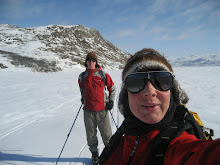
Raven is also a GPS coordinate site for many ice cap travelers. Skiers crossing from east to west or from south to north stop in for a rest day. Dog sled teams do the same, as do occasional snow machine parties. While we were there, we met 2 men from Germany who were looking forward to snorkeling in the Bahamas. They had been working there way across the ice cap for almost a month, with just 2 or 3 days left to go before reaching the Russel glacier, 25 km from my desk.
one of the men had broken his ski. His only choice was to saw it down with his knife and refit the binding. He was overjoyed by doing this, as the traditional Finnish ski set up was just like his: one long ski (for glide), one short (for guide).
The best part of our 3 hour lark, was getting to meet Dennis, a native east Greenlander, who was sledging across the ice cap with his 13 dogs and 2 German tourists. Dennis was very very happy and his skin was very very dark. The later was from the high intensity solar exposure without the admistration of sun block. He wore no sunglasses either, but very trendy European eye glasses. He was not wearing fur. He was one of the happiest people I have ever met. He told me allot about his life in 15 minutes, including, "I don't drink and I don't smoke". Then he introduced me to some of his dogs.
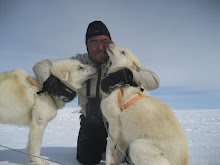
Of course their names are Greenlandic, and I cannot remember them, but the names of the two in the picture translate to, "oil" (because as a pup she had found a bag of waste oil rags and rolled in it) and "failure". Dennis said,
"you are supposed to name them after what they are, or what they do".
"This one is always messing up. He cant do anything correctly".
After this statement he rubbed "failures" head very very lovingly and laughed like the Dali Lami.
While Steve decided we should finally make a serious commitment to planning our own ski trip across the ice, I decided we most certainly must go sledging someday too.
By the way, the dogs all say hello.
On my way home from an evening walk in the hills, I flushed two mallard ducks, a male and female. On top of a nearby promontory we surprised a Willow ptarmigan still in winter plumage. A small flcok of Cananda geese flew over, honking in a well formed "V"
In the early morning, on a flat basalt rock, worn smooth by time, ice, sand, wind and water, now exposed to the warmth of the dry air, I go to stretch and great the day. It is no further from our bedroom door than 500 feet and faces directly into the rising sun. It is wonderful to look first down into the stone then up into the awakening sky, enveloped in yellow glow.
Deep breaths of air enter into my lungs, scented with dry grasses and freshening life. Sometimes,I hear the flapping work of avian effort; a raven beats the wind just over my hair.
Yesterday, Steve and I were invented aboard one of the training missions to Raven. Originally the site of DYE II, an early warning detection radar site, built during the cold war, Raven, now serves as as a soft snow landing site for ski equipped Hercules aircraft. Though the radar station still stands, and has not drifted in, it is completely sequestered from the little camp called, Raven.
Camp Raven, is a temporary camp that is put in every spring then taken down and moved back to the warehouse in Kangerlussuaq every fall. The radar site is a Star Wars type hulk built up on pods with a geodesic dome mounted on top. It is inside this dome, that the satellite dish sits.
Camp Raven is occupied and maintained by two people whose principal objective is surival. After tending to all of their own camp chores, they are also in charge of grooming the ski way, providing surface definitions and weather to various parties as well as maintaining an almost constant communciations link between the aircraft, themselves and Kangerlussuaq.
Raven is also a GPS coordinate site for many ice cap travelers. Skiers crossing from east to west or from south to north stop in for a rest day. Dog sled teams do the same, as do occasional snow machine parties. While we were there, we met 2 men from Germany who were looking forward to snorkeling in the Bahamas. They had been working there way across the ice cap for almost a month, with just 2 or 3 days left to go before reaching the Russel glacier, 25 km from my desk.
one of the men had broken his ski. His only choice was to saw it down with his knife and refit the binding. He was overjoyed by doing this, as the traditional Finnish ski set up was just like his: one long ski (for glide), one short (for guide).
The best part of our 3 hour lark, was getting to meet Dennis, a native east Greenlander, who was sledging across the ice cap with his 13 dogs and 2 German tourists. Dennis was very very happy and his skin was very very dark. The later was from the high intensity solar exposure without the admistration of sun block. He wore no sunglasses either, but very trendy European eye glasses. He was not wearing fur. He was one of the happiest people I have ever met. He told me allot about his life in 15 minutes, including, "I don't drink and I don't smoke". Then he introduced me to some of his dogs.
Of course their names are Greenlandic, and I cannot remember them, but the names of the two in the picture translate to, "oil" (because as a pup she had found a bag of waste oil rags and rolled in it) and "failure". Dennis said,
"you are supposed to name them after what they are, or what they do".
"This one is always messing up. He cant do anything correctly".
After this statement he rubbed "failures" head very very lovingly and laughed like the Dali Lami.
While Steve decided we should finally make a serious commitment to planning our own ski trip across the ice, I decided we most certainly must go sledging someday too.
By the way, the dogs all say hello.
Sunday, May 11, 2008
Happy Mother's Day, Moms.
For the first time in my life, after stopping for lunch on a mountain bike ride, I noticed that the tires on my bicycle were covered with fur. I said to Steve, who was busy trying to eat a six year plus expired cliff bar, "Hey, my wheels are covered with fur"!
We had attempted a ride out to the beginning of the trail we hiked over for 100 miles last summer. We were hoping it would already be snow free and willing to carry us over the country to a hut about 6 miles from the trail head; here we could get away to fish for arctic char, watch for snow geese and perhaps see some loons.
The snow was knee deep and rotten with water running beneath it. I should have worn plastic bread bags over my socks, like our Moms taught us to do when we were kids. We pushed our bikes most of the way, an hour out and an hour back, slogging through wet thaw under blue sky. A small flock of snow geese did fly overhead encouraging spring, lightening our hearts to smile. The lakes were deeply scored across the middle by last winter's dog sled and snow machine tracks; straight lines traveling towards the next landmark, a cairn on a knoll, which had behind it yer another small lake, that when frozen became another "road-way". And so the distance is covered (three days by sledge, 3 hours by snow machine) for the team bound for Sisimiut from Kangerlussuaq.
In the ice free times of the year, one must walk around every little lake, some small enough to pass in an hour, others lapping at your ankles all the day long.
At this first resting place where we stopped for lunch, there is a hunters camp. Two cold war era streamlined trailers are placed on the rock in an "L" formation anchored down by stones and cables. The doors are not locked. Inside there is an oil stove and a propane cook stove and a small kitchen space. There are bunks for sleeping and a table with benches at the back for hanging out. I tap the barometer glass for the sky is filling with mare's tails and sure enough it falls a wee bit down from fair.
The second trailer is a meat locker, hence the reason for the ground being covered with tufts of fur blown like flour about the millers yard. Hocks and hooves and heads and horns also lie about. A pair of snow buntings flit through the air. The peripheral circumference of the little salt lake is melting so that there is a turquoise ring gleaming around it in the sunlight.
The 109Th came and went, after still another week of missions. I am vowing to set up a time lapse camera next year in the warehouse in an attempt to capture a smidgen of what happens in there as crates and boxes and bags and people and coolers and fork lifts and Shannon and Steve and Ed and Sparky and wood pallets and air force pallets and frozen food pallets and do not freeze air sample flasks and solar panels and batteries come and go.
This weekend has been quiet, and the weather beautiful. There are fresh green grasses poking out of the earth. On Monday, four more Hercs will fly north and yet another week of missions will begin. June will arrive in a burst of green before we even know it for the days are nearing there longest.
This past Friday we went down to "dog-lussuaq". Ed had asked one of the men in town who keeps a team of sled dogs if he could feed them some meat we had to pass on. The man obliged us and we all went down to the makeshift kennels to feed the dogs. There are, as best as i can make out, about 7 private kennels which are made up of makeshift fencing which partition more than contain teams of dogs. The dogs are kept on chains inside these partitions. They drink from old plastic drums which there handlers keep filled with water. While this man was dangling 2 pound slices of beef over the cyclone fence to his dogs, a women and her young daughter were moving about inside there dog pack adjusting dog's chains, asking certain dogs to sit, then petting it in its head. The young girl helped the mother remove several caribou hides tied to a sled and they then went about releasing 2 of the 12 or so dogs which took off with tails wagging and hearts pounding and bliss shooting out of their very marrow. It was a joy to see the mother and girl walk off over the dry land with there dogs racing about, but with the dogs getting meat and the other dogs running free, the rest of the inmates began howling and barking and barking and howling and some even fighting so that we decided it was time to go.
We had attempted a ride out to the beginning of the trail we hiked over for 100 miles last summer. We were hoping it would already be snow free and willing to carry us over the country to a hut about 6 miles from the trail head; here we could get away to fish for arctic char, watch for snow geese and perhaps see some loons.
The snow was knee deep and rotten with water running beneath it. I should have worn plastic bread bags over my socks, like our Moms taught us to do when we were kids. We pushed our bikes most of the way, an hour out and an hour back, slogging through wet thaw under blue sky. A small flock of snow geese did fly overhead encouraging spring, lightening our hearts to smile. The lakes were deeply scored across the middle by last winter's dog sled and snow machine tracks; straight lines traveling towards the next landmark, a cairn on a knoll, which had behind it yer another small lake, that when frozen became another "road-way". And so the distance is covered (three days by sledge, 3 hours by snow machine) for the team bound for Sisimiut from Kangerlussuaq.
In the ice free times of the year, one must walk around every little lake, some small enough to pass in an hour, others lapping at your ankles all the day long.
At this first resting place where we stopped for lunch, there is a hunters camp. Two cold war era streamlined trailers are placed on the rock in an "L" formation anchored down by stones and cables. The doors are not locked. Inside there is an oil stove and a propane cook stove and a small kitchen space. There are bunks for sleeping and a table with benches at the back for hanging out. I tap the barometer glass for the sky is filling with mare's tails and sure enough it falls a wee bit down from fair.
The second trailer is a meat locker, hence the reason for the ground being covered with tufts of fur blown like flour about the millers yard. Hocks and hooves and heads and horns also lie about. A pair of snow buntings flit through the air. The peripheral circumference of the little salt lake is melting so that there is a turquoise ring gleaming around it in the sunlight.
The 109Th came and went, after still another week of missions. I am vowing to set up a time lapse camera next year in the warehouse in an attempt to capture a smidgen of what happens in there as crates and boxes and bags and people and coolers and fork lifts and Shannon and Steve and Ed and Sparky and wood pallets and air force pallets and frozen food pallets and do not freeze air sample flasks and solar panels and batteries come and go.
This weekend has been quiet, and the weather beautiful. There are fresh green grasses poking out of the earth. On Monday, four more Hercs will fly north and yet another week of missions will begin. June will arrive in a burst of green before we even know it for the days are nearing there longest.
This past Friday we went down to "dog-lussuaq". Ed had asked one of the men in town who keeps a team of sled dogs if he could feed them some meat we had to pass on. The man obliged us and we all went down to the makeshift kennels to feed the dogs. There are, as best as i can make out, about 7 private kennels which are made up of makeshift fencing which partition more than contain teams of dogs. The dogs are kept on chains inside these partitions. They drink from old plastic drums which there handlers keep filled with water. While this man was dangling 2 pound slices of beef over the cyclone fence to his dogs, a women and her young daughter were moving about inside there dog pack adjusting dog's chains, asking certain dogs to sit, then petting it in its head. The young girl helped the mother remove several caribou hides tied to a sled and they then went about releasing 2 of the 12 or so dogs which took off with tails wagging and hearts pounding and bliss shooting out of their very marrow. It was a joy to see the mother and girl walk off over the dry land with there dogs racing about, but with the dogs getting meat and the other dogs running free, the rest of the inmates began howling and barking and barking and howling and some even fighting so that we decided it was time to go.
Thursday, May 1, 2008
Walking tour
Steve suggested that I write about our room or the kitchen the four of us share here. He has a good idea, but as I took my evening walk last night, along the river, in the rain, I thought that a walking tour of Kangerlussuaq might really go a long way, for this is such a strange place; difficult for most people to immagine.
First the lay of the land. To the east of us, some 10 miles up a sandy wash boarded jeep track, which tourists pay dearly to ride over in large tundra- tired 4x4s, stands the terminus of the Russle Glacier. One of thousands of outlet glaciers which extend into valleys and rivers and fjords from off of the inland ice cap, the Russle presents itself to us with a wall of calving ice. If you were to start here, at this most dramatic place, you would follow along the old glacial bed now filled by the Watson river. This river, frozen solid a month ago, is now a muddy boil of ice shards and silt. It is running fast, Id guess making at least 15 knots toward the fjord. It snakes through a sandy boulder strewn valley fenced in to the north and south by long intrusions of granitic rock coverde by a thin layer of earth matted by the thick roots of the tundra. You will pass through low areas of moist heath and willow and shrub birch where ponds or lakes lay now empty of ice. The grasses and sedges from last summer stand tawny and stiff, tuffs of matted cotton grass, like so many soggy rabbit tails, mark the edges of these small bodies of still water. You will rise and roll over hills where the tundra will become more dense. Then you will drop again untill finaly you arive at the end of the jeep track at the head of a runway looking directly west out the fjord. Though you will not see the sea, it is there, far away in the shimmering distance.
Turn right and you will walk only a quarter of a mile before you are in the heart of town. There is a post office, a small grocer, a hotel and the airport.
The airport, the largest in Greenland is also the Homeland Rule's largest buisiness. With a population just under 57 000, more than 200 000 people and tons and tons of cargo, move through this municipality of less than 500 citizens every year. The hotel is nothing fancy, though there is a gift shop, which sells ivory carvings, candy bars, post cards and seal skin pocket books. There is a cafe and a 5 star restaurant. The airport is a walk -in off- the street, no security kind of place, though it is dirty and small, (standing room only for an aerbus wait) it is not unusual to rub elbows with other people, mostly Danes, wearing fur jackets, polar bear teeth "aumuelts" or narwhal tusk rings. The counter is just 2 booths long as there is only one choice of carrier. The wood floor is scuffed. Cigarette smoke palls the air. You would check into the hotel from here by turning away from the check in counter and walking 50 feet past the kiosk. When you board the aerbus 330, to return to Europe, (or any of the dash 7 s to fly somewhere else around Greenland) you walk outside and enter the plane from the tail, up a set of portable stairs painted bright yellow.
Across the street which is a pot- holed, puddle -filled, almost two laned road, is the Pillersuisoq, the grocery store. Inside there are 4 aisles no longer than 40 feet long. You can buy sardines, crackers, digestive biscuits, canned beets, UHT milk products, salted licorice, dark rye bricks of bread (our favoite), Danish cheeses, rich butter, weird sandwich meats, seafood spreads (even weirder) , frozen vegatables, whole fishes, whale meat, and plastic children's toys. There is also an assortment of Adidas jogging suits, underwear for him and her, (one brand), sundries and elctronica. Behind the checkout counter, (two registers) you may ask for hard liquor, wine, cigarettes, matches, batteries or fresh baked bread. Remember, all the food, excpet for the fish and whale and baked bread, comes from Denmark, so one must select one's food very carefully by a dicey decyphering game combined of looking at the pictures on the lables and "reading" the ingredients (in Danish). One of our favoite discoveries is, "FRUGTPALAEG", med jordbaer. Ingen konserveringsstoffer. I think this means, " fruit strips, with dates and raisens. All natural fruit preserves". I havent looked it up in the dictionary yet however! These strips of fruit, without anything else added, come packaged like processed cheese slices, with the little pieces of parchement paper between each layer. They are wonderful on the hearty Sweedish WASA crackers along with a smear of Nutella or a hunk of very fine, very aged, Danish cheese. The package is the best part as it is emblazoned by a cartoon monkey hanging from a vine with his finger up his nose.
Above the grocery is the meteorologist's weather station. Facing down the road towards the west, standing in front of the "butikin" (store in Danish) with the airport on your left, you will see some red, one story buildings. This is the complex of Air Greenland's cargo shipping wharehouse and administrative offices. There is aslo a police station, a hostel and some housing. If you were to follow this road for 8 miles, you would come to the harbour. The harbour has no boats in it as it is still frozen. There is only one building here and three landing crafts hauled out on the sand. Once or twice a year a shallow draft freighter visits form Denmark bearing containers of merchandise, construction materials, new cars and trucks and snow machines. Up above from the harbour another few miles, is Kellyville, population 4. Kellyville, deserves its own story later, but is basicly a National Science Foundation mandated Incoherent Scatter Radar sigh. One of only nine in the world.
Let's go back to the end of the jeep track again, with the ice cap at your back and the airport runway in front of you. Take a left. You will now be walking along the fence of the eastern most end of the 9000 foot long runway and the steep sandy bank of the river, where it takes a sharp bend. Before you now lies the part of Kangerlussuaq where most of the people live and sleep and where the children play. This flat, sandy steppe bears the bulk of the hulking old concrete panel buildings and wooden and corrugated metal wharehouses left over by the American and Danish military days. There is a tennis court which probalby has'nt had any "love" since Nixon was president and a modern children's play ground, bright in contrast to the chain link fence and bleached net of the court.
Here on your right built up above the river is a row of buildings that were once barracks. These in order; the RDAF (Royal Danish Air Force) the, Hotel Tuu Tuu, meaning cariobu (pronounced doot doot) the KISS building, the jail, the NY 109Th Air Gaurd's building and The Polar Bear (a convience store/ bar that sells ice cream pops, crackers, cookies and weird sexual gag gifts). There are another three identical buildings (all are about 200 feet long by 50 feet wide and 2 stories tall) which serve as apartment housing for families that work here.
Now you are at the bottom of the street and standing on the bridge which is made of wood, that spans the Watson river. The river pours into the head of the fjord through a narrow gorge of scalloped basalt and empties itslef out into a wide flat plain of reflected cloud, sand bank and water. If you were to keep going from here, you would begin to climb imediately up a steep sandy road either having to turn left, back towards the east, or right out towards the west. Here is the large geological bulwark called Black Hills, ontop of which stands much aviation navigation aids, radars, and radio towers. Ravens are always soaring on the winds up here. It is a fine place to go for views and fresh air or to try and catch a glimpse of musk oxen browsing.
Turn back across the river and walk up the same road you just walked down, heading towards the airport. You will pass a few streets branching off to your right, west down the north bank of the fjord. These streets lead to some homes and more 2 story town- house style company housing projects. They also lead out to wharehouses both abandoned and in use, where the city works, aiport runway equipment, garbage trucks and storage facilites lay . You will pass the recreation center, the bowling alley and a small government building before returning to the tennis courts. Behind the playground, about five hundered feet, stand the two buildings we lease for our cargo/ gear storage. Above all this, on a bank along the south flank of the runway, are the hangers and airport ground crew facilities. Just past the hanger is a small, one story wooden building that has become the Kangerlussuaq museum. Closed for winter hours.
Tired from all of this walking, find the KISS building. Go in the front door, walk down a long carpeted hallway past many closed bright orange doors, up a flight of stairs to room #213. This is our room, a tidy second story 30x20 foot space with a window that looks at somebody else's window on the second story of the hotel tuu tuu. By standing close to the window, which does open, and bending my neck to the east, I can see the river and the hills and the ice cap. This view beckons, but now I must sleep.
First the lay of the land. To the east of us, some 10 miles up a sandy wash boarded jeep track, which tourists pay dearly to ride over in large tundra- tired 4x4s, stands the terminus of the Russle Glacier. One of thousands of outlet glaciers which extend into valleys and rivers and fjords from off of the inland ice cap, the Russle presents itself to us with a wall of calving ice. If you were to start here, at this most dramatic place, you would follow along the old glacial bed now filled by the Watson river. This river, frozen solid a month ago, is now a muddy boil of ice shards and silt. It is running fast, Id guess making at least 15 knots toward the fjord. It snakes through a sandy boulder strewn valley fenced in to the north and south by long intrusions of granitic rock coverde by a thin layer of earth matted by the thick roots of the tundra. You will pass through low areas of moist heath and willow and shrub birch where ponds or lakes lay now empty of ice. The grasses and sedges from last summer stand tawny and stiff, tuffs of matted cotton grass, like so many soggy rabbit tails, mark the edges of these small bodies of still water. You will rise and roll over hills where the tundra will become more dense. Then you will drop again untill finaly you arive at the end of the jeep track at the head of a runway looking directly west out the fjord. Though you will not see the sea, it is there, far away in the shimmering distance.
Turn right and you will walk only a quarter of a mile before you are in the heart of town. There is a post office, a small grocer, a hotel and the airport.
The airport, the largest in Greenland is also the Homeland Rule's largest buisiness. With a population just under 57 000, more than 200 000 people and tons and tons of cargo, move through this municipality of less than 500 citizens every year. The hotel is nothing fancy, though there is a gift shop, which sells ivory carvings, candy bars, post cards and seal skin pocket books. There is a cafe and a 5 star restaurant. The airport is a walk -in off- the street, no security kind of place, though it is dirty and small, (standing room only for an aerbus wait) it is not unusual to rub elbows with other people, mostly Danes, wearing fur jackets, polar bear teeth "aumuelts" or narwhal tusk rings. The counter is just 2 booths long as there is only one choice of carrier. The wood floor is scuffed. Cigarette smoke palls the air. You would check into the hotel from here by turning away from the check in counter and walking 50 feet past the kiosk. When you board the aerbus 330, to return to Europe, (or any of the dash 7 s to fly somewhere else around Greenland) you walk outside and enter the plane from the tail, up a set of portable stairs painted bright yellow.
Across the street which is a pot- holed, puddle -filled, almost two laned road, is the Pillersuisoq, the grocery store. Inside there are 4 aisles no longer than 40 feet long. You can buy sardines, crackers, digestive biscuits, canned beets, UHT milk products, salted licorice, dark rye bricks of bread (our favoite), Danish cheeses, rich butter, weird sandwich meats, seafood spreads (even weirder) , frozen vegatables, whole fishes, whale meat, and plastic children's toys. There is also an assortment of Adidas jogging suits, underwear for him and her, (one brand), sundries and elctronica. Behind the checkout counter, (two registers) you may ask for hard liquor, wine, cigarettes, matches, batteries or fresh baked bread. Remember, all the food, excpet for the fish and whale and baked bread, comes from Denmark, so one must select one's food very carefully by a dicey decyphering game combined of looking at the pictures on the lables and "reading" the ingredients (in Danish). One of our favoite discoveries is, "FRUGTPALAEG", med jordbaer. Ingen konserveringsstoffer. I think this means, " fruit strips, with dates and raisens. All natural fruit preserves". I havent looked it up in the dictionary yet however! These strips of fruit, without anything else added, come packaged like processed cheese slices, with the little pieces of parchement paper between each layer. They are wonderful on the hearty Sweedish WASA crackers along with a smear of Nutella or a hunk of very fine, very aged, Danish cheese. The package is the best part as it is emblazoned by a cartoon monkey hanging from a vine with his finger up his nose.
Above the grocery is the meteorologist's weather station. Facing down the road towards the west, standing in front of the "butikin" (store in Danish) with the airport on your left, you will see some red, one story buildings. This is the complex of Air Greenland's cargo shipping wharehouse and administrative offices. There is aslo a police station, a hostel and some housing. If you were to follow this road for 8 miles, you would come to the harbour. The harbour has no boats in it as it is still frozen. There is only one building here and three landing crafts hauled out on the sand. Once or twice a year a shallow draft freighter visits form Denmark bearing containers of merchandise, construction materials, new cars and trucks and snow machines. Up above from the harbour another few miles, is Kellyville, population 4. Kellyville, deserves its own story later, but is basicly a National Science Foundation mandated Incoherent Scatter Radar sigh. One of only nine in the world.
Let's go back to the end of the jeep track again, with the ice cap at your back and the airport runway in front of you. Take a left. You will now be walking along the fence of the eastern most end of the 9000 foot long runway and the steep sandy bank of the river, where it takes a sharp bend. Before you now lies the part of Kangerlussuaq where most of the people live and sleep and where the children play. This flat, sandy steppe bears the bulk of the hulking old concrete panel buildings and wooden and corrugated metal wharehouses left over by the American and Danish military days. There is a tennis court which probalby has'nt had any "love" since Nixon was president and a modern children's play ground, bright in contrast to the chain link fence and bleached net of the court.
Here on your right built up above the river is a row of buildings that were once barracks. These in order; the RDAF (Royal Danish Air Force) the, Hotel Tuu Tuu, meaning cariobu (pronounced doot doot) the KISS building, the jail, the NY 109Th Air Gaurd's building and The Polar Bear (a convience store/ bar that sells ice cream pops, crackers, cookies and weird sexual gag gifts). There are another three identical buildings (all are about 200 feet long by 50 feet wide and 2 stories tall) which serve as apartment housing for families that work here.
Now you are at the bottom of the street and standing on the bridge which is made of wood, that spans the Watson river. The river pours into the head of the fjord through a narrow gorge of scalloped basalt and empties itslef out into a wide flat plain of reflected cloud, sand bank and water. If you were to keep going from here, you would begin to climb imediately up a steep sandy road either having to turn left, back towards the east, or right out towards the west. Here is the large geological bulwark called Black Hills, ontop of which stands much aviation navigation aids, radars, and radio towers. Ravens are always soaring on the winds up here. It is a fine place to go for views and fresh air or to try and catch a glimpse of musk oxen browsing.
Turn back across the river and walk up the same road you just walked down, heading towards the airport. You will pass a few streets branching off to your right, west down the north bank of the fjord. These streets lead to some homes and more 2 story town- house style company housing projects. They also lead out to wharehouses both abandoned and in use, where the city works, aiport runway equipment, garbage trucks and storage facilites lay . You will pass the recreation center, the bowling alley and a small government building before returning to the tennis courts. Behind the playground, about five hundered feet, stand the two buildings we lease for our cargo/ gear storage. Above all this, on a bank along the south flank of the runway, are the hangers and airport ground crew facilities. Just past the hanger is a small, one story wooden building that has become the Kangerlussuaq museum. Closed for winter hours.
Tired from all of this walking, find the KISS building. Go in the front door, walk down a long carpeted hallway past many closed bright orange doors, up a flight of stairs to room #213. This is our room, a tidy second story 30x20 foot space with a window that looks at somebody else's window on the second story of the hotel tuu tuu. By standing close to the window, which does open, and bending my neck to the east, I can see the river and the hills and the ice cap. This view beckons, but now I must sleep.
Subscribe to:
Posts (Atom)