Yesterday, the morning awoke across the Watson river with a thick woolen sweater that suggested snow. The surface of the earth and the small ponds and vast lakes even the fjord remained frozen. We had planned a hike up in the hills to the north of the town, a wandering, map less hike following the undulating ridges west along the fjord. I left sunglasses and sunblock on the shelf. Sure enough, by the time we reached the top of our thousand foot climb up the yellow and orange lichen covered granite formation folded with quartz, the sun began to burn through the cloud layer which only an hour ago seemed so thick. Dozens of fox and arctic hare ran before us, though all we could see of them were there tracks. Such a large empty landscape seems so forlorn in the absence of it's beasts; the sign of there having passed, indeed of them invisibly sitting ,twitching noses and sniffing as you pass adds a fullness, a completeness to the space.
We walked ever westward mostly having the firmness of rock beneath our soles, sometimes dry, barren, snow free, iron hard clay, through which poked last year's sedges, harebells and grass. Sometimes we wound up post holing through shaving cream soft snows deep in the drifts between ledges.
By noon the sun was blazing but the wind still cold. We sat in a lee on top of the dark heath made up of miniature rhododendron and blueberry (all day I feasted on last summers blue berries. Perfectly preserved by winter's freeze, they had received just enough sun to be warm, sweet and juicy).
We descended down between cliffs through a shrub forest of willows to the paved road which runs the 14 km from the airport in kangerlussuaq to the harbor near Kellyville.
We walked the remaining several miles back along Saturday's quiet runway to KISS.
Though the usual day off is Sunday, last week's busy flight schedule was such that we worked all through the week and weekend pausing only on this past Thursday afternoon when the last LC 130 (successfully)left the island.
Graciously rewarded with two days off in a row this weekend as compensation (especially after so much traveling and learning and settling in and meeting people and such) allowed for some serious relaxation; as I sat drinking sweet almond tea in an armchair with a book this morning, I felt as if I were on a vacation (we're actually getting paid for this though)!
But today broke away from the clouds at an even faster pace promising some more glorious weather and the icy ruts in the roads began to melt again and since we had learned, on yesterday's march, that the road to the harbour was free, we struck out on our bikes for a hilly ride on our very fine single speed steeds. Of course when we returned, we ate silly Danish cookies and took a nap.
Sunday, April 13, 2008


Friday, April 11, 2008
Town
Kangerlussuaq is not really a town, as we would call such a place. It is not, nor was it ever, a traditional Inuit village. Located at the head of the fjord, almost 150 km from the sea, the "town" is too far inland to have ever offered any good incentives for traveling so far out of one's way, unless for the rare occurrence of a savssat (savssats occur when mammals can no longer reach the open sea from inside of a fjord in a single breath due to a rapidly increasing sea ice band in the fjord. When the fjord was entered there may have only been a small band of ice separating the sea from the fjord, however, as time passed, maybe hours, maybe days, the length of the ice became so long as to prevent the narwhals or belugas from being able to return to the open sea). In fact, not even the local herd of muskoxen are native to kangerlussuaq; introduced to western Greenland from eastern Greenland during the 1960s these Ovibos moschatus have prospered from a very small herd to numbers in the thousands.
Knagerlussuaq means "long fjord". Sondre stromfjord, the name the Danes gave to this place, also means, "very long fjord, to the south"...or something like that. The reason there is anything here now is due in part to Danish colonization the American's concern with the cold war era's potential for Soviet missile attacks and the contemporary Greenland Home Rule's largest airport on the island; the hub for all of Greenland.
The topography also allowed for a very long runway due to the flat sandy moraine left behind in time from a massive glacier. All of which remains, being the Watson river born from the inland ice cap 25 km to the east.
As things are relatively quiet in our world now that the air guard is gone, we were able to rattle around in our old ford truck today doing errands. First we went over to airport cargo. There we meet Tim who speaks excellent English as well as danish and Greenlandic (as does most everyone that works here whether they are Greenlandic or danish) who helped us with a bunch of multi colored papers and receipts which allowed us to pick up a box of "sensitive electrical equipment" shipped from Switzerland by a scientist for a project later on this summer.
We then crossed the ice rutted, thawing, paved street to the tele post where we met a descendant of Knud Rasmussen, named the same, who stamped our paper work with an archaic stamper that must work under a load of about 25 foot pounds of pressure. Back across the street to the airport security to get our badges which will allow for us to enter onto the taxi way during flight operations with the air guard. A brief pause while awaiting the clerk allowed for me to flip through a magazine on the lobby table; "Elite", a danish publication portrayed the uber wealthy flashing gems and yachts and sealskin bikinis under seemingly Bermudian skies. In the office Greenlandic people, come for a job in the air industry (as clerks or municpalities trades) from remote settlements, worked in jeans and modern European styles sipping coffee from delicate clear glass mugs in stainless steel holders, while cell phones chimed, air planes landed and taxied for take off outside the large glass windows.
After lunch we rolled over to the Pilersuisoq (piller shoo so waagg) "Kanger's" only grocery store. We deposited returnable bottles for danish krone and learned that the Greenlandic soccer team is to play Cambridge on may 21st. Promising not to work that day in order to watch the "champions" we left for the accountant. Then it was off to the only gas pumps around; one diesel, one benzene (gas). We used our plastic card and punched in numbers. The directions are in Danish. We filled the tanks, 367 krone for 96 liters. Roughly 78 us dollars for 24 gallons of gas.
Steve saw a pure white arctic fox yesterday evening.
Knagerlussuaq means "long fjord". Sondre stromfjord, the name the Danes gave to this place, also means, "very long fjord, to the south"...or something like that. The reason there is anything here now is due in part to Danish colonization the American's concern with the cold war era's potential for Soviet missile attacks and the contemporary Greenland Home Rule's largest airport on the island; the hub for all of Greenland.
The topography also allowed for a very long runway due to the flat sandy moraine left behind in time from a massive glacier. All of which remains, being the Watson river born from the inland ice cap 25 km to the east.
As things are relatively quiet in our world now that the air guard is gone, we were able to rattle around in our old ford truck today doing errands. First we went over to airport cargo. There we meet Tim who speaks excellent English as well as danish and Greenlandic (as does most everyone that works here whether they are Greenlandic or danish) who helped us with a bunch of multi colored papers and receipts which allowed us to pick up a box of "sensitive electrical equipment" shipped from Switzerland by a scientist for a project later on this summer.
We then crossed the ice rutted, thawing, paved street to the tele post where we met a descendant of Knud Rasmussen, named the same, who stamped our paper work with an archaic stamper that must work under a load of about 25 foot pounds of pressure. Back across the street to the airport security to get our badges which will allow for us to enter onto the taxi way during flight operations with the air guard. A brief pause while awaiting the clerk allowed for me to flip through a magazine on the lobby table; "Elite", a danish publication portrayed the uber wealthy flashing gems and yachts and sealskin bikinis under seemingly Bermudian skies. In the office Greenlandic people, come for a job in the air industry (as clerks or municpalities trades) from remote settlements, worked in jeans and modern European styles sipping coffee from delicate clear glass mugs in stainless steel holders, while cell phones chimed, air planes landed and taxied for take off outside the large glass windows.
After lunch we rolled over to the Pilersuisoq (piller shoo so waagg) "Kanger's" only grocery store. We deposited returnable bottles for danish krone and learned that the Greenlandic soccer team is to play Cambridge on may 21st. Promising not to work that day in order to watch the "champions" we left for the accountant. Then it was off to the only gas pumps around; one diesel, one benzene (gas). We used our plastic card and punched in numbers. The directions are in Danish. We filled the tanks, 367 krone for 96 liters. Roughly 78 us dollars for 24 gallons of gas.
Steve saw a pure white arctic fox yesterday evening.
Thursday, April 10, 2008
Sigh
The first evolution of the National Science Foundation's chartered fleet of Hercules, ski equipped (LC) 130 cargo aircraft has been completed. We have a peaceful 10 days to catch our breath before another exciting show; April 21 - the 25Th. Meanwhile the NY 109Th Air Guard has flown away to their home base in Scotia, NY for a short R and R before taking to wing again on a week long re-fueling mission to Alert Bay, Canada high on the edge of northern Ellesmere island.
The remainder of this month's flights are for the staging of the upcoming inland ice traverse (known as GRIT: Greenland Inland Traverse....unfortunately there is not an open contest on renaming this most uneventful of acronyms) from Thule to Summit Station by tractor. During May, there will be almost three weeks of flights, mostly to the North, to Thule supporting an ongoing ice coring project called, NEEM, as well as the traverse. During June and July, at the peak of the arctic summer a magnificent attempt will be made to choreograph the movements of airplanes, cargo and passengers; as the solstice reaches its apogee so does the intensity of the myriad of researchers studying Greenland.
Despite a day of bad weather up on the ice cap (the story about the tents being blown away has been corrected by an eye witness at the camp; the tents were not blown away, they merely failed) preventing any flights, mechanical problems with the planes, technical woes and the infamous learning curve (where is the curved part anyway?)we were able to get 5 missions flown in successfully moving almost 70,000 pounds of stuff, from people to fuel to snow machines.
Today is clear and cold and bright but not warm. Steve detailed his grandfather's fishing pole while I cleaned up our community kitchen. Since the 25th of March, we have been sharing our limited space with all of our fellow staff as they made their ways and way-lays to and from. Now the place has come to a calm of five quiet souls from a boisterous hurricane of 15.
On Monday we will begin putting together some of the cargo we have received so far this year for the season's upcoming research projects. One such item is a canister of high-test "Cajun" bear spray and a box of heavy gauge electric fencing. The archaeologist who intends to bend his or her face to the briefly yielding polar earth, diligently sweeping away sand and grit with a paint brush, does not desire to be interrupted by "Nanook" the great white bear.
The remainder of this month's flights are for the staging of the upcoming inland ice traverse (known as GRIT: Greenland Inland Traverse....unfortunately there is not an open contest on renaming this most uneventful of acronyms) from Thule to Summit Station by tractor. During May, there will be almost three weeks of flights, mostly to the North, to Thule supporting an ongoing ice coring project called, NEEM, as well as the traverse. During June and July, at the peak of the arctic summer a magnificent attempt will be made to choreograph the movements of airplanes, cargo and passengers; as the solstice reaches its apogee so does the intensity of the myriad of researchers studying Greenland.
Despite a day of bad weather up on the ice cap (the story about the tents being blown away has been corrected by an eye witness at the camp; the tents were not blown away, they merely failed) preventing any flights, mechanical problems with the planes, technical woes and the infamous learning curve (where is the curved part anyway?)we were able to get 5 missions flown in successfully moving almost 70,000 pounds of stuff, from people to fuel to snow machines.
Today is clear and cold and bright but not warm. Steve detailed his grandfather's fishing pole while I cleaned up our community kitchen. Since the 25th of March, we have been sharing our limited space with all of our fellow staff as they made their ways and way-lays to and from. Now the place has come to a calm of five quiet souls from a boisterous hurricane of 15.
On Monday we will begin putting together some of the cargo we have received so far this year for the season's upcoming research projects. One such item is a canister of high-test "Cajun" bear spray and a box of heavy gauge electric fencing. The archaeologist who intends to bend his or her face to the briefly yielding polar earth, diligently sweeping away sand and grit with a paint brush, does not desire to be interrupted by "Nanook" the great white bear.
Tuesday, April 8, 2008
Tuesday
Winter returned to the head of the fjord. Everything that was water yesterday is solid ice again. Snow flurries and is hurried aross the hard land as quickly as it falls by a very dry, very cold wind. Two tents were blown away yesterday at Camp Raven. They experienced gusts up to 35 knots. Fortunately there are a few permanent hard structures there with heat and everyone is fine.
Out of three planes scheduled to fly today (one to the summit of the ice cap where Summit Station is located at 10.000 ft, and two more for the final put in of Camp Raven) only one tried; but "Skier nine five" (we refer to the "Hercs" by their tail numbers) given the go ahead to attempt a flight up to Summit, had to shut down due to a mechanical issue before ever leaving the tarmac.
After diner, broiled tuna steaks with quinoa and peas follwed by our very special dessert of rehydrated, dehydrated strawberries and canned pineapple, I took a walk about.
I passed the musuem which is closed untill summer and snooped around inside an abandoned USAF building marked by a placard outside as the "FUELS FACILITY". Since the heat has been shut off since the end of the cold war (no pun intended) paint peels from the walls. A parts manual for an old MACK truck engine lay on the floor open to a page with an illustration of a filter group. The next room had a station with a venting hood and some testing equipment, most likely used for anyalasing fuel samples. Cansiters of fuel lay around amongst the curls of paint and leaves of paper from some other forgotten manuals.
I went back outside following the runway towards the old USAF medical clinic, another building given up by the US to Greenland Home Rule. Every window has been broken. The old wooden stairs are not much better off. The corrugated green steel siding has faded but the red on white first aid cross looks fresh. I enter the second floor through a broken window over looking the fjord but as soon as I am inside I leave again. I did not bring a flashlight and the peeling walls, heavy doors and long abandoned rooms are not nearly as inviting as the arctic air.
Now I am in some sort of a bone yard. Wrecked volvos, rabbits and Russian Nias lay around half in half out of the crusty, dirty snow and cracked ice. Parts of "reindeer" (caribou) poke out of the frozen snow; tufts of white hair, antler, bone, sinew and hoof. I crouch to read something I recognize to be english. It is a baggage tag from SAS that says, " luggage is like an ice flow on the outside and an archipeligo on the inside". I am not sure what this means.
There is a 50 something foot steel hulled, hard chined sailboat on a trailer that looks like it was built out of the same enormous timbers the US used in constructing some of their buldings with. I notice the boat has been strapped to this trailer with some of our cargo straps. She is missing her masts, rigging and rudder.
As I walk the street that follows the fjord back to the KISS building, I pass some sort of club house for locals. Outside the door are musk oxen hides piled four feet tall. Parked vehicles range from toyota pick ups to land rovers with snorkels and tundra tires. I see a man walk in with seal parka and jeans. A little girl in moon boots roams the street playing with a cell phone. As i pass along outside the recreation center (also built by the Americans) I can hear the distninct sound of a game of raquetball.
In front of the post office, some one is gathering up the plywood signs with pictures of poltical candiates for the mayor of Sisimiut Komune. The head of butchered musk ox, saved for its horns and skull proturdes from a snow drfit. In the tall yellow grasses a raven gave a small stone to its mate who took it from his beak with her own.
Out of three planes scheduled to fly today (one to the summit of the ice cap where Summit Station is located at 10.000 ft, and two more for the final put in of Camp Raven) only one tried; but "Skier nine five" (we refer to the "Hercs" by their tail numbers) given the go ahead to attempt a flight up to Summit, had to shut down due to a mechanical issue before ever leaving the tarmac.
After diner, broiled tuna steaks with quinoa and peas follwed by our very special dessert of rehydrated, dehydrated strawberries and canned pineapple, I took a walk about.
I passed the musuem which is closed untill summer and snooped around inside an abandoned USAF building marked by a placard outside as the "FUELS FACILITY". Since the heat has been shut off since the end of the cold war (no pun intended) paint peels from the walls. A parts manual for an old MACK truck engine lay on the floor open to a page with an illustration of a filter group. The next room had a station with a venting hood and some testing equipment, most likely used for anyalasing fuel samples. Cansiters of fuel lay around amongst the curls of paint and leaves of paper from some other forgotten manuals.
I went back outside following the runway towards the old USAF medical clinic, another building given up by the US to Greenland Home Rule. Every window has been broken. The old wooden stairs are not much better off. The corrugated green steel siding has faded but the red on white first aid cross looks fresh. I enter the second floor through a broken window over looking the fjord but as soon as I am inside I leave again. I did not bring a flashlight and the peeling walls, heavy doors and long abandoned rooms are not nearly as inviting as the arctic air.
Now I am in some sort of a bone yard. Wrecked volvos, rabbits and Russian Nias lay around half in half out of the crusty, dirty snow and cracked ice. Parts of "reindeer" (caribou) poke out of the frozen snow; tufts of white hair, antler, bone, sinew and hoof. I crouch to read something I recognize to be english. It is a baggage tag from SAS that says, " luggage is like an ice flow on the outside and an archipeligo on the inside". I am not sure what this means.
There is a 50 something foot steel hulled, hard chined sailboat on a trailer that looks like it was built out of the same enormous timbers the US used in constructing some of their buldings with. I notice the boat has been strapped to this trailer with some of our cargo straps. She is missing her masts, rigging and rudder.
As I walk the street that follows the fjord back to the KISS building, I pass some sort of club house for locals. Outside the door are musk oxen hides piled four feet tall. Parked vehicles range from toyota pick ups to land rovers with snorkels and tundra tires. I see a man walk in with seal parka and jeans. A little girl in moon boots roams the street playing with a cell phone. As i pass along outside the recreation center (also built by the Americans) I can hear the distninct sound of a game of raquetball.
In front of the post office, some one is gathering up the plywood signs with pictures of poltical candiates for the mayor of Sisimiut Komune. The head of butchered musk ox, saved for its horns and skull proturdes from a snow drfit. In the tall yellow grasses a raven gave a small stone to its mate who took it from his beak with her own.
Subscribe to:
Posts (Atom)
Kangerlussuaq's golf club house

should we wait for the musk ox to play through?
dwarf fireweed

Greenlandic natl. flower
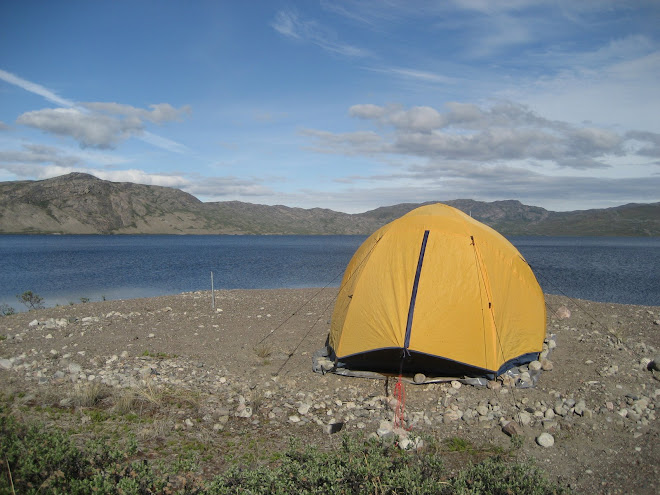
Lake Ferguson site
summer home
ventifacts still with ice: march 2008

circles of time
ventifact rock

scuptures of weather
headwaters of the watson river

this is not a moulin
glacial edge

spring calving
rhododendron, Laponica

a bonsai effect in the wild
Russel's glacier

water, cave, serac
Dye II

me and Steve and Raven
sled dogs

happy quick
wish you were here

chickweed

arctic harebells

edible, taste mildly nutty
Denis with "oil" and "failing"
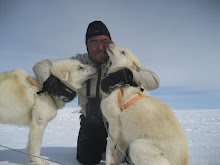
"it is a happy life"
Lunch break

wish you were here with us!
"Main Street" Kangerlussuaq

looking north from the bridge, KISS bldg. is red.
Watson River Gorge Bridge

watch as the level ct.s to rise over this season!
sled crossing

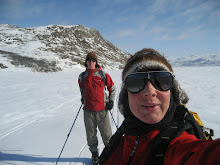
sking across lake furgusen
last winter's musk ox hunt

heads awaiting further processing
Raven's food put in

Hey! they've got fig newmans!
sunset over the Watson r.

sunday bike ride west
