A verticle shaft in a glacier, kept open by falling water, is a, moulin.I suppose the size of the shaft and the ammount of water drilling through the ice, though signifiagant, does not have defining prematers; a moulin could be a small stream and a small hole or it could be a river plunging down through a tunnel size cavern all the way to the bedrock.
Many of the reserchers that departed Kangerlussuaq almost a month ago, are now returning. We sit with some of them around the diner table, or stirke up long conversations in the hall. Sometimes, we are the first to see their most recent presentations. Jason Box, from the Byrd polar research Institue, a member of the, Extrmeme Ice Survey, a team captruing the speed of glaciers through time lapse photography, kept our attention piqued well up untill midnight last night. Through his dedication to capturing some of the most important glaciers in western Greenland, through the lenses of cameras mounted in fixed weatherproof boxes kept charged by solar panels, and his ease of communicating the drama of science to lay people, we learn perhaps too much, too quickly, and still, not enough.
I face dispare and also sadness as I watch a Niagra Falls ammount of water pour down into a hole "you could drive buses into" in the ice cap. Most likely it reaches the bedrock. There are theories that these moulins could be draining 2 miles down onto the basal layer of the island, over which the ice sheet rests, thus lubricating the bottom of the ice sheet causing it to flow faster than normal. Indeed, the time lapse photography compared with satleite telemetry and ground truthing, have proven that glaciers are traveling faster. Simple observations form tide line, show them to be retreating further.
But this is alarming, for now the global consortium of scientists are begining to feel cetainites. Certanties that not only may they have predicted the sea level rise to be less than it may actualy become, but that the climate too will change much more radicly and rapidly than first presumed. All nations across the globe need to agree to some sort of KYOTO protocol.
Still, all things are constanlty changing, and I am relieved from a circiling depression, like vultures, flying around a dieing beast, to a smiling wonder; a sudden, expanding, almost euphoric peace, for there is more knowledge being assinmliated throughout the world today then ever before in the history of the human race, and there is also, or so i bleive, more hope, more awarneess, more we can do.
By simply istening to and observing, any one of the dozens of reserachers we help to support, there comes though a presence of fearless comapssion. A final relinquishing of acceptance into the understanding of the total inter-connectedness of all beings; wether it be a glacier and a rock or a person and a honey bee.
As the earth exhales, we inhale. As we exhale, the earth inhales. As we learn to sit for longer and longer spans of time, in the quiet, silent, places, we learn how to watch a flower open, or an ice sheet move, or a landscape brighten with day. We learn that these places begin in our minds and expand into our hearts, then retract again into our mind; what does it mean to us, this flower this glacier, this cloud cover, clearing?
To some, they mean so much that they devout a life time of studying to just one tiny aspect of life. To the rest of us, we must smile that we are rleived of that duty for this time, so that we may embrace all that is around us, wherever we are, whatever we are doing, for like glaciers, we are moving faster and faster and yet, we are also, retreating.
Sunday, June 1, 2008


Monday, May 26, 2008
road trip
On Saturday, Sparky loaded up the old Ford 4x4 and drove a group of us up to the edge of the ice cap. There is a long, sandy road that winds out of Kangerlussuaq along the Watson river to where the rock and heath end and the ice begins. A few miles before one parks, abruptly against the wall of seracs, the road turns into a jeep track. Muddied and rutted, steep and boggy, any attempt to drive out here is certainly not for the unordained - offroader; it is an experiment in the physics of torsional chassis dynamics and luck. We made it to the Russel's glacier just as the sun erupted from the overcast sky.
Covering the rock is a soil that is only about a foot deep. In this soil grows a variety of heaths and shrubs, flowers, sedges, grasses, lichens, moss, fungi, and the rhododendron, Lapponica. The tiny purple trusses of this northern most rhododendron are just beginning to open, some in full display, a bright, transparent purple flower smaller than the thumb.
All around in the air, birds chirped, flies buzzed, wind tickled the senses. Beside us, leaned the glacier's exposed, decaying, fragmented edge. Lacerated shards of blue so deep and clear and dull and scrathced and broken, yet sharp; threatening, beckoning.
From underneath roared water. It came from hollowed caves. It poured out from crevasses over quartz veined gneiss.It tumbled gray with silt, turquoise with light. We all stood waiting for a piece of the glacier to release itself to time aided by gravity, undermined by these waters, but none were ready to fall.
We hiked along the edge over barren rock towards a lake as silent and calm as a secret.
Steve and I had brought along our bikes. WE left the group of glaciologists and hydrologists that Sparky had brought out for the day, and headed back the 30 km to town. We passed a place in the road that seemed otherworldly. Rock and glacier, storm building sky, and an earth reveling in the glories of spring. Dust stirred through the air. No noise but the wind, creaking ice. Cairns built long ago, rumored burial grounds, lakes resistive to breezes, reflecting stone and cloud and blue and flashes of the sun.
Along the way we met a pair of travelers also out on bikes. A man an women. She from Denmark, he from Kurdistan. He had been rented the most pitiful bike I had ever seen go so far away from any help. The rim had been split, the rubber on the tire was lacerated and cut and broken down by UV rays. The tube had been punctured and they had no repair kit.
Luckily we had our bike tools and tube patches. We also had a first aid kit. The man with the flat had some string. I used 2 steri strips to hold the tape inside the rim together to keep the spoke screw heads from poking the tube. Steve patched the tire. WE cut strips from a felt cloth to line the inside of the tire, further protecting the tube, then I lashed string around the worst of the tire to give it new tread. I had taken 2 bike pumps for some readon this day, so we could afford to lend them one.
Later that night, back in Kangerlussuaq, they returned the pump to us. They had been able to ride out the whole way!
Covering the rock is a soil that is only about a foot deep. In this soil grows a variety of heaths and shrubs, flowers, sedges, grasses, lichens, moss, fungi, and the rhododendron, Lapponica. The tiny purple trusses of this northern most rhododendron are just beginning to open, some in full display, a bright, transparent purple flower smaller than the thumb.
All around in the air, birds chirped, flies buzzed, wind tickled the senses. Beside us, leaned the glacier's exposed, decaying, fragmented edge. Lacerated shards of blue so deep and clear and dull and scrathced and broken, yet sharp; threatening, beckoning.
From underneath roared water. It came from hollowed caves. It poured out from crevasses over quartz veined gneiss.It tumbled gray with silt, turquoise with light. We all stood waiting for a piece of the glacier to release itself to time aided by gravity, undermined by these waters, but none were ready to fall.
We hiked along the edge over barren rock towards a lake as silent and calm as a secret.
Steve and I had brought along our bikes. WE left the group of glaciologists and hydrologists that Sparky had brought out for the day, and headed back the 30 km to town. We passed a place in the road that seemed otherworldly. Rock and glacier, storm building sky, and an earth reveling in the glories of spring. Dust stirred through the air. No noise but the wind, creaking ice. Cairns built long ago, rumored burial grounds, lakes resistive to breezes, reflecting stone and cloud and blue and flashes of the sun.
Along the way we met a pair of travelers also out on bikes. A man an women. She from Denmark, he from Kurdistan. He had been rented the most pitiful bike I had ever seen go so far away from any help. The rim had been split, the rubber on the tire was lacerated and cut and broken down by UV rays. The tube had been punctured and they had no repair kit.
Luckily we had our bike tools and tube patches. We also had a first aid kit. The man with the flat had some string. I used 2 steri strips to hold the tape inside the rim together to keep the spoke screw heads from poking the tube. Steve patched the tire. WE cut strips from a felt cloth to line the inside of the tire, further protecting the tube, then I lashed string around the worst of the tire to give it new tread. I had taken 2 bike pumps for some readon this day, so we could afford to lend them one.
Later that night, back in Kangerlussuaq, they returned the pump to us. They had been able to ride out the whole way!
Wednesday, May 21, 2008
Monday morning we awoke to rain. Tuesday wet snow; the flakes so big and heavy, they fell to the mud in clumps. Today the sky was blown to pieces and the wind, from off of the North Atlantic, piercing.
Last night I ran east along the river on the low road out past the golf course. The roads are all sand and have a few wash outs which I leap across carefully. I look up into the head of the valley at the lumpy hills that stand alone. They are similar to pingos but are not pingos. Pingos are solitary hills of ice pushed up by the pressures of permafrost, covered by earth.
The cloud's shadows fell across the rolling earth darkening the foreground, illuminating the distance. The ice cap gave off a silty gray sheen like a well used aluminum pan.
The wind is at my back the whole way out,I feel the landscape belonging. When I turn to run back towards town I face into 15 knots of air and my heart rate exceeds my pace. Still I follow the river to the fjord.
The trash in Kangerlussuaq all gets burned. There is no recycling except for the hard plastic soda bottles and the small, stocky necked glass bottles. Everything else gets hauled up to the burn pit and lit. When it has become ash it is pushed down a bank where it waits for the waters from the river and the fjord.
Meanwhile, dumpsters must wait for the man who drives the truck to come and haul them away. Our's was full of trash sent out from Summit. One by one the ravens congregated on the top of the dumpster attracted by the freshly thawed food waste. I counted 28 birds, each one larger than a Schnauzer, ripping and tearing into trash; no comparison to the finches and juncos we left swinging in the cherry tree from a liter sized feeder.
Late Tuesday afternoon Ole arrived with his big diamond earring and his safety green city shop suit,made in Denmark. The ravens followed the truck up the hill.
The post office has cut back on its hours. They are now open from 9-10 in the morning. 1-3 in the afternoon.
I went to the warehouse that supplies the only grocery store by the same name; Pilersuissoq. Another man with a Danish name and a cigarette stood on top of a small electric fork lift and took care of my order. There was some confusion translating pounds into kilograms and deciding which bunch of toilet paper to buy, but after some mildly painful paperwork for Jen's, I left with all of the flour and coffee and T.P. Summit had requested for the week.
On the other side of town at Air Greenland the cargo freight service, Tim leafed through an enormous volume of paperwork with the quickness of a dog scratching up a bone as I peered over his shoulder trying to avoid the cigarette smoke, doing my best to decipher from the Danish and Greenlandic type, what might be the missing box I was hoping to find. Tim made a couple phone calls, first to Kulusuk on the east coast, then to Tasilaq, also on the east coast, and after hanging up and taking a sip of coffee said with a smile, "it is in Tasaliq".
Phone conferences with 5 or 6 people, some in Denver, some at Summit, some in NY help us all to feel just a little less confused about the next flight week. Afterwards I return to our warehouse to count life vests, pack camp kitchens kits and prepare small "suitcase" generators for the field.
There is fresh snow in the high hills. Everyone is feeling optimistic that this front has killed off most of the mosquito larvae that were wriggling in standing pools of water Sunday afternoon.
A diner guest, from the University of Copenhagen, discussed a book he read recently (published only in danish). Detailing all of the major problems Greenland is facing as a developing nation, it touched on: hesitation to commit to using English or danish for government affairs/ global trade, drug abuse, suicide, emigration of youth, in house bribery and corruption, interests in resource extraction such as mining and drilling for oil, climate change, tourism, fishing and consolidation of remote settlements into the larger towns. Though there is certainly much to be critical of, I find it not shy of amazing that on the worlds biggest island, where not one single settlement or village or township or city is connected to another by any other means than by boat or commercial airplane, where only fifty something thousand people live, who all happened to be mostly self sufficient, fur wearing hunters only 50 years ago, is today, comprised of a car driving, cell phone talking, freight forwarding, computer dependant, world wide webbing, pop music - rapping, vacationing in Thailand, micro beer brewing culture.
Or at least that's what I see in Kangerlussuaq (pop. <1000) and have seen in Sisimiut(pop. 5000), and have heard about in Nuuk (pop 20,000). So that's half the country right there.
Kangerlussuaq, the international hub for all of Greenland boasts not one single Doctor or Dentist. There is no emergency care. Flights flying over have requested care from the flight tower only to be told to carry on either to Iceland or Canada.
Last Sunday afternoon Steve and I collected fossils of fish in a stream bed running through a canyon of clay and sediment at the far west end of the runway. Dan, a reservist from the 109Th joined us. He served three tours over seas. Two in Iraq, at Fullujah, and "ZONE G". One, on an aid mission to Islamabad.
Dan talked about mortar fire, which have a range of three miles. Those firing the mortars, would fill a small space between the mortar and the cap with water in the evening, up in the mountains. In the morning, when the sun hit, and the water that had frozen, thawed, the mortar would fire but there would be no one accountable at the site.
I glanced around the arid arctic desert and thought about that; looking three miles off into the distance from where a mortar would come. It was the first time I ever walked with a soldier, in a fossil bed, that could have been in Pakistan, for as warm as it was that day, and thought about being "shelled".
When Dan finished his story I noticed his face was red. Maybe it was just from too much sun or from repeatedly bending down to pick up a fossil, or maybe it was from the emotions that were no doubt coursing through his being, but at any rate, he paused and smiled at the stillness, or at me, or at Steve or at the fossils he had found, or at the wonderful presence of being of alive.
Last night I ran east along the river on the low road out past the golf course. The roads are all sand and have a few wash outs which I leap across carefully. I look up into the head of the valley at the lumpy hills that stand alone. They are similar to pingos but are not pingos. Pingos are solitary hills of ice pushed up by the pressures of permafrost, covered by earth.
The cloud's shadows fell across the rolling earth darkening the foreground, illuminating the distance. The ice cap gave off a silty gray sheen like a well used aluminum pan.
The wind is at my back the whole way out,I feel the landscape belonging. When I turn to run back towards town I face into 15 knots of air and my heart rate exceeds my pace. Still I follow the river to the fjord.
The trash in Kangerlussuaq all gets burned. There is no recycling except for the hard plastic soda bottles and the small, stocky necked glass bottles. Everything else gets hauled up to the burn pit and lit. When it has become ash it is pushed down a bank where it waits for the waters from the river and the fjord.
Meanwhile, dumpsters must wait for the man who drives the truck to come and haul them away. Our's was full of trash sent out from Summit. One by one the ravens congregated on the top of the dumpster attracted by the freshly thawed food waste. I counted 28 birds, each one larger than a Schnauzer, ripping and tearing into trash; no comparison to the finches and juncos we left swinging in the cherry tree from a liter sized feeder.
Late Tuesday afternoon Ole arrived with his big diamond earring and his safety green city shop suit,made in Denmark. The ravens followed the truck up the hill.
The post office has cut back on its hours. They are now open from 9-10 in the morning. 1-3 in the afternoon.
I went to the warehouse that supplies the only grocery store by the same name; Pilersuissoq. Another man with a Danish name and a cigarette stood on top of a small electric fork lift and took care of my order. There was some confusion translating pounds into kilograms and deciding which bunch of toilet paper to buy, but after some mildly painful paperwork for Jen's, I left with all of the flour and coffee and T.P. Summit had requested for the week.
On the other side of town at Air Greenland the cargo freight service, Tim leafed through an enormous volume of paperwork with the quickness of a dog scratching up a bone as I peered over his shoulder trying to avoid the cigarette smoke, doing my best to decipher from the Danish and Greenlandic type, what might be the missing box I was hoping to find. Tim made a couple phone calls, first to Kulusuk on the east coast, then to Tasilaq, also on the east coast, and after hanging up and taking a sip of coffee said with a smile, "it is in Tasaliq".
Phone conferences with 5 or 6 people, some in Denver, some at Summit, some in NY help us all to feel just a little less confused about the next flight week. Afterwards I return to our warehouse to count life vests, pack camp kitchens kits and prepare small "suitcase" generators for the field.
There is fresh snow in the high hills. Everyone is feeling optimistic that this front has killed off most of the mosquito larvae that were wriggling in standing pools of water Sunday afternoon.
A diner guest, from the University of Copenhagen, discussed a book he read recently (published only in danish). Detailing all of the major problems Greenland is facing as a developing nation, it touched on: hesitation to commit to using English or danish for government affairs/ global trade, drug abuse, suicide, emigration of youth, in house bribery and corruption, interests in resource extraction such as mining and drilling for oil, climate change, tourism, fishing and consolidation of remote settlements into the larger towns. Though there is certainly much to be critical of, I find it not shy of amazing that on the worlds biggest island, where not one single settlement or village or township or city is connected to another by any other means than by boat or commercial airplane, where only fifty something thousand people live, who all happened to be mostly self sufficient, fur wearing hunters only 50 years ago, is today, comprised of a car driving, cell phone talking, freight forwarding, computer dependant, world wide webbing, pop music - rapping, vacationing in Thailand, micro beer brewing culture.
Or at least that's what I see in Kangerlussuaq (pop. <1000) and have seen in Sisimiut(pop. 5000), and have heard about in Nuuk (pop 20,000). So that's half the country right there.
Kangerlussuaq, the international hub for all of Greenland boasts not one single Doctor or Dentist. There is no emergency care. Flights flying over have requested care from the flight tower only to be told to carry on either to Iceland or Canada.
Last Sunday afternoon Steve and I collected fossils of fish in a stream bed running through a canyon of clay and sediment at the far west end of the runway. Dan, a reservist from the 109Th joined us. He served three tours over seas. Two in Iraq, at Fullujah, and "ZONE G". One, on an aid mission to Islamabad.
Dan talked about mortar fire, which have a range of three miles. Those firing the mortars, would fill a small space between the mortar and the cap with water in the evening, up in the mountains. In the morning, when the sun hit, and the water that had frozen, thawed, the mortar would fire but there would be no one accountable at the site.
I glanced around the arid arctic desert and thought about that; looking three miles off into the distance from where a mortar would come. It was the first time I ever walked with a soldier, in a fossil bed, that could have been in Pakistan, for as warm as it was that day, and thought about being "shelled".
When Dan finished his story I noticed his face was red. Maybe it was just from too much sun or from repeatedly bending down to pick up a fossil, or maybe it was from the emotions that were no doubt coursing through his being, but at any rate, he paused and smiled at the stillness, or at me, or at Steve or at the fossils he had found, or at the wonderful presence of being of alive.
I cannot say, for I have certainly not walked in his shoes, but I think that despite any one of our pasts, or any of our fears about the future, or all of the trials of Greenland's akward teenage years of modern growth and accpetance into the global community, there is a real value in the calrity of the air here, and in the peace that extends and extends and stretches and keeps racing away with all of these subtle flashing colors and the clouds falling across the soft rounds hills, and the knowledge of there being musk ox and caribou and hares and fox all watching you,sniffing the same air, that makes one have a very very profound sense of living life, and not just as a human, but as the very stuff of life itslef.
Thursday, May 15, 2008
Migration
Birds are arriving. Their songs are liquid music; water and the promise of spring. The sparrows, black and red capped, perch and rustle in the willows. They call and chirp and flit and float, from silver tipped shrub branch to orange,lichen covered boulder.
On my way home from an evening walk in the hills, I flushed two mallard ducks, a male and female. On top of a nearby promontory we surprised a Willow ptarmigan still in winter plumage. A small flcok of Cananda geese flew over, honking in a well formed "V"
In the early morning, on a flat basalt rock, worn smooth by time, ice, sand, wind and water, now exposed to the warmth of the dry air, I go to stretch and great the day. It is no further from our bedroom door than 500 feet and faces directly into the rising sun. It is wonderful to look first down into the stone then up into the awakening sky, enveloped in yellow glow.
Deep breaths of air enter into my lungs, scented with dry grasses and freshening life. Sometimes,I hear the flapping work of avian effort; a raven beats the wind just over my hair.
Yesterday, Steve and I were invented aboard one of the training missions to Raven. Originally the site of DYE II, an early warning detection radar site, built during the cold war, Raven, now serves as as a soft snow landing site for ski equipped Hercules aircraft. Though the radar station still stands, and has not drifted in, it is completely sequestered from the little camp called, Raven.
Camp Raven, is a temporary camp that is put in every spring then taken down and moved back to the warehouse in Kangerlussuaq every fall. The radar site is a Star Wars type hulk built up on pods with a geodesic dome mounted on top. It is inside this dome, that the satellite dish sits.
Camp Raven is occupied and maintained by two people whose principal objective is surival. After tending to all of their own camp chores, they are also in charge of grooming the ski way, providing surface definitions and weather to various parties as well as maintaining an almost constant communciations link between the aircraft, themselves and Kangerlussuaq.
Raven is also a GPS coordinate site for many ice cap travelers. Skiers crossing from east to west or from south to north stop in for a rest day. Dog sled teams do the same, as do occasional snow machine parties. While we were there, we met 2 men from Germany who were looking forward to snorkeling in the Bahamas. They had been working there way across the ice cap for almost a month, with just 2 or 3 days left to go before reaching the Russel glacier, 25 km from my desk.
one of the men had broken his ski. His only choice was to saw it down with his knife and refit the binding. He was overjoyed by doing this, as the traditional Finnish ski set up was just like his: one long ski (for glide), one short (for guide).
The best part of our 3 hour lark, was getting to meet Dennis, a native east Greenlander, who was sledging across the ice cap with his 13 dogs and 2 German tourists. Dennis was very very happy and his skin was very very dark. The later was from the high intensity solar exposure without the admistration of sun block. He wore no sunglasses either, but very trendy European eye glasses. He was not wearing fur. He was one of the happiest people I have ever met. He told me allot about his life in 15 minutes, including, "I don't drink and I don't smoke". Then he introduced me to some of his dogs.
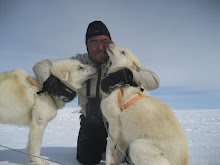
Of course their names are Greenlandic, and I cannot remember them, but the names of the two in the picture translate to, "oil" (because as a pup she had found a bag of waste oil rags and rolled in it) and "failure". Dennis said,
"you are supposed to name them after what they are, or what they do".
"This one is always messing up. He cant do anything correctly".
After this statement he rubbed "failures" head very very lovingly and laughed like the Dali Lami.
While Steve decided we should finally make a serious commitment to planning our own ski trip across the ice, I decided we most certainly must go sledging someday too.
By the way, the dogs all say hello.
On my way home from an evening walk in the hills, I flushed two mallard ducks, a male and female. On top of a nearby promontory we surprised a Willow ptarmigan still in winter plumage. A small flcok of Cananda geese flew over, honking in a well formed "V"
In the early morning, on a flat basalt rock, worn smooth by time, ice, sand, wind and water, now exposed to the warmth of the dry air, I go to stretch and great the day. It is no further from our bedroom door than 500 feet and faces directly into the rising sun. It is wonderful to look first down into the stone then up into the awakening sky, enveloped in yellow glow.
Deep breaths of air enter into my lungs, scented with dry grasses and freshening life. Sometimes,I hear the flapping work of avian effort; a raven beats the wind just over my hair.
Yesterday, Steve and I were invented aboard one of the training missions to Raven. Originally the site of DYE II, an early warning detection radar site, built during the cold war, Raven, now serves as as a soft snow landing site for ski equipped Hercules aircraft. Though the radar station still stands, and has not drifted in, it is completely sequestered from the little camp called, Raven.
Camp Raven, is a temporary camp that is put in every spring then taken down and moved back to the warehouse in Kangerlussuaq every fall. The radar site is a Star Wars type hulk built up on pods with a geodesic dome mounted on top. It is inside this dome, that the satellite dish sits.
Camp Raven is occupied and maintained by two people whose principal objective is surival. After tending to all of their own camp chores, they are also in charge of grooming the ski way, providing surface definitions and weather to various parties as well as maintaining an almost constant communciations link between the aircraft, themselves and Kangerlussuaq.
Raven is also a GPS coordinate site for many ice cap travelers. Skiers crossing from east to west or from south to north stop in for a rest day. Dog sled teams do the same, as do occasional snow machine parties. While we were there, we met 2 men from Germany who were looking forward to snorkeling in the Bahamas. They had been working there way across the ice cap for almost a month, with just 2 or 3 days left to go before reaching the Russel glacier, 25 km from my desk.
one of the men had broken his ski. His only choice was to saw it down with his knife and refit the binding. He was overjoyed by doing this, as the traditional Finnish ski set up was just like his: one long ski (for glide), one short (for guide).
The best part of our 3 hour lark, was getting to meet Dennis, a native east Greenlander, who was sledging across the ice cap with his 13 dogs and 2 German tourists. Dennis was very very happy and his skin was very very dark. The later was from the high intensity solar exposure without the admistration of sun block. He wore no sunglasses either, but very trendy European eye glasses. He was not wearing fur. He was one of the happiest people I have ever met. He told me allot about his life in 15 minutes, including, "I don't drink and I don't smoke". Then he introduced me to some of his dogs.
Of course their names are Greenlandic, and I cannot remember them, but the names of the two in the picture translate to, "oil" (because as a pup she had found a bag of waste oil rags and rolled in it) and "failure". Dennis said,
"you are supposed to name them after what they are, or what they do".
"This one is always messing up. He cant do anything correctly".
After this statement he rubbed "failures" head very very lovingly and laughed like the Dali Lami.
While Steve decided we should finally make a serious commitment to planning our own ski trip across the ice, I decided we most certainly must go sledging someday too.
By the way, the dogs all say hello.
Subscribe to:
Posts (Atom)