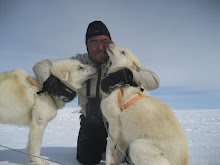
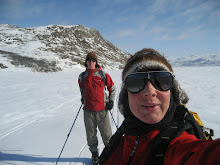
This picture shows me standing in the middle of the ski way at summit station on the Greenland ice cap. The reason it is called a ski way rather than a runway is obvious if you really think a little about physics and airplanes, verses snow and cement. You can see the flags vanishing to a point in the distance. The point in the distance is less than 3 miles behind me. This picture was shot on a calm day in the fall. I would say the ambient temperature was around -20 F, or even warmer, because I am not wearing a neck gaiter or my big- issued, down parka. The down parkas we are issued, weigh about 12 pounds new and cost over 800 dollars. I have a radio in my back pack along with a thermos of hot water, snickers bars (which have already frozen into jaw breakers). Steve took the picture, so someone is with me. Further more, other people know that Steve and I had set off for a hike.
Mexico covers 756,006 square miles of land. The ice cap of Greenland- covering five sixths of the worlds largest island, is roughly the same size as Mexico; since Greenland's total land mass is 840, 003 square miles.
Imagine yourself now being lost on this ice cap in a blizzard. You cannot think about the blizzards you have seen in Michigan or Connecticut or Maine, because in fimiliar contexts, your imagination will be biased: you might be traveling home from Christmas caroling with a church group, you might be out on the side walk shoveling- everything is still near and the lights can be seen, motors heard, your chances of dieing are nil. It would be better for you to try and imagine being lost at sea in a fog in the arctic in a skiff that has run out of gas. You didn't tell anyone where you were going-which doesn't matter since you are not where you were going. You are lost. You don't have a radio or a flare or a tent or even an issued parka.
The temperature is well below freezing. It is minus 35 F. The wind is blowing a gale. The only navigational aids are flags which have long ago become obscured in the frost and wind and blowing snow. There is nothing else to delineate your landscape. Remember you are at sea, far off shore, or in the middle of the flattest part of the storming Sahara; you are on top of the world,s largest ice cap, alone. Your chances of dieing now, are superb.
On the 16Th of this month, unbeknownst to Steve, or anyone else up at camp, two of the camp staff went for a joy ride on snow machines. Maybe they even had had something to drink. They went out into fresh winds- not yet gale force. They followed the bright black flags down to the end of the ski way ducking behind the wind screens, exhilerated and then, ideling the engines at the far end, they were overcome with the immidate knowledge that they had better go back. But they lost one another and themselves. The mechanic stopped when he knew he was lost and dug a hole with the shovel that had, by luck, been on the back of his machine. After 16 hours living like a sled dog on the trail, he dug himslef out, started up his machine and went back to camp where he was shocked to learn that his friend was not home.The other man, the man now in the burn center of the University of California, at Davis, kept going. In fact, his machine, when found 3 days later, was far away from the ski way; you will have to forgive me for not being able to cite the exact distance, but roughly 13 miles, and was run out of gas. As soon as it was known that a person was missing out on the ice cap, Steve launched a search and rescue mission involving every resource they had. For three days he was beside the phone and radio maintianing communcation links; catching only short naps, he continued with the neseccary camp duties required of him while commiserating with and encouraging the three remaining crew to remain hopeful.
The only news story I could find relating this incident was published by Fox news, who repeated the National Science Foundation's blurb. Giving no names, other than, NASA, the NSF, the Royal Danish Air force, "people in Kangerlussuaq", and, the 109Th Air National Guard, I found it outrageous that the photo they slectected, encaptioned, "Ariel view of the ice cap" was a floating ice berg. If you watch this crap, shame on you for being so unintelligent-you are probably still trying to figure out what the differences are between a runway, and a ski way.
After 60 hours, the lost man was found. He was spotted by a colluege of ours, a man of both Danish and Inuit ancestry. A man named, Basse. Basse and I spoke on the phone a few days after the lost man was found. Basses described to me what he was looking for as being what is known as a body drift. He happened to be driving a tracked snow cat when he noticed a "speck on the windhseild -but it wasn't a speck". He kept his eyes on the mark and as they neared the body drift, for after 50 hours lost man was presumed to be dead lost man, the "body drift", stood up! He was 12 miles from camp.
The damage done, was mostly to his hands. Leather, thinsualte lined mittens with no cuffs had slid down below the wrist bone and were no longer able to be pulled up, once the hunting stage of cold (as low as minus 50 with wind chill) had set into the fingers. After this, ischemia occurs, which is loss of blood flow. Next, cells begin to die. When his clothes were cut off of him, inside the warmth of the station, his mittens and socks were not among the articles removed. Ice crystals held them to flesh. Lost man, thought to be dead man, now found man, was medivaced first, to the hospital in Nuuk, (the capitol of Greenland) and later, to the UC Davis burn center near his family. Last I heard, he had gone in for a surgical procedure; a final analysis of the vascular and cellular damage sustained before what we are all presuming to be amputations of both hands from mid wrist down.
Over 4000 years ago, the Inuit migrated to Greenland form North America. They developed senses which enabled them to survive sea ice travel, long dark winters subsisting off of raw meat, isolation- stymied only by mythological visitors: the northern lights, understood to be the spirits of their ancestors, senses that were accute and as critical as instincts. Basse and I have spoken a few times about the knowelged of his people's past and the responsibilities of being aware still, divided by intersecting aspects of modern times. I listened to him well. As soon as I heard that he had gone up to the ice cap, a place no ancient Greenlandic person ever would have gone-for there is nothing there to offer the living, other than death; I knew he would find the man he was looking for. I dint know that he would find him alive.
To give some perspective on how the people of Greenland view this story, I could find no mention of it in their news. It is no where as near as extraordinairy as recent findings of methane gas or integrating schools with non native speakers. To them, it must be not so much a moment's story- now told between family over cell phone or via email, as it is a permission slip into recollection; an ability to beleive again in a past now thought to be more incredible than real. Life goes on. Back at home In Kangerlussuaq, on the west coast of Greenland, Basse sips his coffee, plays with his kids, surfs the hundreds of thousands of satellite channels on his wide screen TV and gazes out at the changing fjord: it is begining to melt, slowly. He might even be thinking about trying again to grow a lawn this summer. Or maybe he is thining about a speck, on a vast, white, seeminlgy endless surface of 40 below where someone from the spirit world lingered- just long enough, to help show a lost, white man, his blundering way home.