This morning I awoke to a soft cool rain blowing against our window. Standing out on the back door , facing the river, I could hear the distinct song of the arctic snow bunting, sweet in comparison to the croaking bark of the ravens. For the first time in over a week I have had time now to sit and enter some thoughts. The past days have been full of cargo planes coming and going, some leaving cargo to be further assimilated and sent elsewhere by commercial air, some needing additional pay loads from us, which we had already prepared, and finally the Piece De Resistance, a C5 Galaxy cargo carrier, one of the world's largest cargo planes landed Monday afternoon with close to 200 000 pounds of cargo.
Originally designed to transport close to a million pounds of cargo, the C5 has had to cut back on it's payload due to age and repairs now made prohibitive due to lack of replaceable parts, still, with both fore and aft cargo openings (the nose lifts open like the jaw of a shark) this six story high, football field long air plane is truly remarkable to behold. Working around it causes one to feel very very small like a mote of dust before a star.
We added a few pallets of cargo to the behemoth and this went off without a hitch, which was very pleasing to us, as there had been some very late nights reworking palletized cargo for other lifts on LC 130s. The cargo aboard the C5 was divided between the new tractors and gear needed for the inland traverse from Thule on the NW coast to Summit, and for NEEM, a Danish drilling project located halfway between the points just mentioned.
The goal of the traverse is to prove that it can be done. Already proven in the Antarctic by the South Pole Traverse team, traversing of fuel and supplies seems to be the answer to the rising cost of fuel while also helping to diminish the carbon foot print of operating LC 130s for all of our cargo needs. Already employed in places such as Summit and more often, at smaller field sites, are wind generators and solar panels, but neither of these are yet up to the capacity required to supply enough of the load demanded at places such as Summit.
The NEEM drilling project is hoping to drill to a depth well over 2500 meters over the next three years. The knowledge gained, if successful, from these ice cores will provide the first record of what the earth's climate was like during the last inter glacial period (known as the Eemian)almost 130 000 years BP. Although similar drilling projects have occurred at diffirent sites on the Greenland ice cap, none of these have been able to produce ungarbled Eemian ice. Garbled ice being sedimentary layers of a glacier marbled by bedrock, melt water from the residual core heat of the earth, and friction from the ice cap, etc etc..at any rate I am doing my best to research this one and will keep you abreast of my findings.
Basically, the knowledge from this core, which will be the first of its type will give very clean, very pure climate signals from the onset of the last interglacial period which will deeply enhance "our" abilities to create more accurate climate models predicting the extent of temperature elevations, sea level gain and ice cap and glacial melt.
It is really, very exciting, and the traverse team, known as GRIT (Greenland inland traverse) will be passing through NEEM's camp in mid June; a further boon for a more carbon friendly cargo re supply opportunity over the next few years. The NEEM site does have a ski way capable of landing LC 130s, similar to the one used at Summit, Raven and other places in the Arctic and Antarctic supplied by skied "birds".
Our time here is moving as fast as the cargo we ship and at times, is just as challenging to keep track of. The research being done here in Greenland is amazing and by the end of the day I sometimes find my head spinning with ideas both concerning my work as well as trying to conceptualize at least some, of what the people, whose cargo I am handling, so easily understand.
This work is both an education and juggling act. A logistical arena of comedies and concerns and wonders. The moments of stillness which are special and rare, find the landscape slowly turning towards spring. Brief chances of getting away into the hills are snatched like the treasures they are. We remind ourselves of where we are and what we are doing by pausing on a hill, far above the runway town, to stare at an antler dropped last year by a caribou laying upon a boulder. Moving water is suddenly heard. A narrow slip of melting snow cuts its way down to the river already widening, racing toward the fjord.
Wednesday, April 30, 2008


Saturday, April 19, 2008
Logistic tree.
Were I to be really clever, a true geek, I would draw out a flow chart illustrating how funding comes from the NSF to CPS who then leases space in Kangerlussuaq from a subsidiary company owned and operated by The Greenland Home Rule allowing the four of us based here in Kangerlussuaq to do our work, scan it and post it as a large photo on my blog. However, wording must suffice. But first, a few acronyms should be defined:
The NSF is of course, the national science foundation.
CPS is much abbreviated. The "C" stands for CH2MHill. The "P" for Polar and the "S" for services.
Formerly known as VPR (which was short for VECO Polar resources) the polar resources branch of this banyan tree was recently bought out by CH2MHill.
I must go on; the polar resources part of VECO now the polar services shoot of CH2MHill, is still the same company.
Back around 2004 a group of friends that had been working for many years for the Antarctic program took an opportunity. The contract for the company that the NSF was then funding to do the logistical work on the Antarctic continent at Palmer, McMurdo Station and south pole was coming up for renewal. This group of very talented very dynamic people felt they could branch off and start there own company under the capital umbrella of VECO. They formed VPR and began offering science logistical support all over the top of the world.
If you select the link I have titled as "our company" you will be sent to VPR's site which has not yet been changed to CPS. This site offers links to all of the places in the Arctic where VPR (CPS) provides logistical support.
Gosh, I'm sorry, the first last thing I ever thought Id do was have a blog. The second last thing I ever thought Id do was blog about major corporations; especially corporations that I have only a basic understanding of! To add to this labyrinthine tale of acronymic dialouge, I should point out that we are not paid by any of the companies or corporations mentioned above, but by someone called RTX.
The main office for CPS is in Litttleton CO. There is only a handful of people who work there. All of them will at one point in time or another deploy to Greenland or Alaska or Russia or Svalbard to do field work either as project coordinators, camp managers or intelligently, just to investigate situations and or possibilities for a Principal Investigator. Sometimes a long trip is made just to speak with an actual person about a seemingly impossible air charter to a remote corner of the world.
The reasons for being based out of kangerluusuaq are simple, this is the largest runway in all of Greenland, capable of landing the largest of military cargo aircraft. Today, kangerlussuaq serves as the central hub for all of the country running 4 flights a week every week of the year between Copenhagen and kangerlussuaq, on an Aerobus 333-200 (averaging 249 seats). The annual number of people flying into or through kangerlussuaq is over 200.000. though most continue on aboard a 757 or a Dash 7 to other cities such as Nuuk (the capitol), sisimiut, and Ilullisat, now an UNESCO site or on to villages or settlements. In a country of less than 55.000 people, this is a remarkable statistic.
The massive installation of infrastructure built during WWII, created a plethora of hangers, warehouses, and dormitory style, two story flats. There is even a recreation center and an outdoor tennis court. When the Danes gave up their governance over Greenland, all of these buildings were rolled over into Home Rule ownership. Today everything about Kangerlussuaq is centered around its single lane run way: the airport, the hotel, the workers supporting both, a bit of tourism, one grocer, a pizzaria and us!
Because the NSF contracts the NY air national guard to fly so many missions to Greenland each summer season (late march- late august) and because we need warehouses to hold all of our equipment and supplies (this includes space in a 2000 square foot freezer for food) and because there must be beds and meals and showers and laundry and Internet connections for all of the hundreds of people that will pass through here, Kangerlussuaq, with all of its pre-existing previously vacated buildings and its long runway with plenty of apron space available was a perfect sight.
The NSF is of course, the national science foundation.
CPS is much abbreviated. The "C" stands for CH2MHill. The "P" for Polar and the "S" for services.
Formerly known as VPR (which was short for VECO Polar resources) the polar resources branch of this banyan tree was recently bought out by CH2MHill.
I must go on; the polar resources part of VECO now the polar services shoot of CH2MHill, is still the same company.
Back around 2004 a group of friends that had been working for many years for the Antarctic program took an opportunity. The contract for the company that the NSF was then funding to do the logistical work on the Antarctic continent at Palmer, McMurdo Station and south pole was coming up for renewal. This group of very talented very dynamic people felt they could branch off and start there own company under the capital umbrella of VECO. They formed VPR and began offering science logistical support all over the top of the world.
If you select the link I have titled as "our company" you will be sent to VPR's site which has not yet been changed to CPS. This site offers links to all of the places in the Arctic where VPR (CPS) provides logistical support.
Gosh, I'm sorry, the first last thing I ever thought Id do was have a blog. The second last thing I ever thought Id do was blog about major corporations; especially corporations that I have only a basic understanding of! To add to this labyrinthine tale of acronymic dialouge, I should point out that we are not paid by any of the companies or corporations mentioned above, but by someone called RTX.
The main office for CPS is in Litttleton CO. There is only a handful of people who work there. All of them will at one point in time or another deploy to Greenland or Alaska or Russia or Svalbard to do field work either as project coordinators, camp managers or intelligently, just to investigate situations and or possibilities for a Principal Investigator. Sometimes a long trip is made just to speak with an actual person about a seemingly impossible air charter to a remote corner of the world.
The reasons for being based out of kangerluusuaq are simple, this is the largest runway in all of Greenland, capable of landing the largest of military cargo aircraft. Today, kangerlussuaq serves as the central hub for all of the country running 4 flights a week every week of the year between Copenhagen and kangerlussuaq, on an Aerobus 333-200 (averaging 249 seats). The annual number of people flying into or through kangerlussuaq is over 200.000. though most continue on aboard a 757 or a Dash 7 to other cities such as Nuuk (the capitol), sisimiut, and Ilullisat, now an UNESCO site or on to villages or settlements. In a country of less than 55.000 people, this is a remarkable statistic.
The massive installation of infrastructure built during WWII, created a plethora of hangers, warehouses, and dormitory style, two story flats. There is even a recreation center and an outdoor tennis court. When the Danes gave up their governance over Greenland, all of these buildings were rolled over into Home Rule ownership. Today everything about Kangerlussuaq is centered around its single lane run way: the airport, the hotel, the workers supporting both, a bit of tourism, one grocer, a pizzaria and us!
Because the NSF contracts the NY air national guard to fly so many missions to Greenland each summer season (late march- late august) and because we need warehouses to hold all of our equipment and supplies (this includes space in a 2000 square foot freezer for food) and because there must be beds and meals and showers and laundry and Internet connections for all of the hundreds of people that will pass through here, Kangerlussuaq, with all of its pre-existing previously vacated buildings and its long runway with plenty of apron space available was a perfect sight.
Tuesday, April 15, 2008
Gronland
Every morning we start out work by sifting through a fabulous amount of documents, calendars, emails and project allocations. The task lasted until noon today as we are coming upon another busy flight week and so many crinkles and bumps in our information technology needed addressing so we can all be on the same page about so many scientists and field camp workers, their logistics and inventory. It is a humbling call to be a part of a so small group of people who are largely responsible for making research in Greenland possible. It is too easy to get caught up in the dust of the warehouse or the whirring of the hard drive, the declaration of hazardous material's, the counting of sleeping bags and insulated boot liners to recall the true objective; help create an environment at such and such place that is conducive to data collection, food preparation, radio comms and warm safe sleep.
The work of these researchers astounds me. A research scientist must not only go routinely into the challenge of the deep field, but are at home, professors actively teaching and lecturing while raising families, planning expeditions and always, applying for grants, posting web sites, publishing papers. I could dedicate all of my free time, which isn't much here, to pouring over their works. Inspired by their noble struggles for a better global acknowledgement of the importance of there studies, mostly concerning all aspects of climate change, they work for at least some acceptance, if only a small rise in the level of public understanding of what we are all up against in our undoubtedly dramatic future of incredibly awesome, very frightening, definately life changing global cimate flux.
The draw back is that it is difficult to integrate oneself into this already tiny, non traditional, airport worker community. I could start to play indoor soccer with the women's team, but I would much rather hike or ride bikes with Steve. I think baby sitting for a mom with children between the ages of 4 and 12 would be a great way to learn Inuit and Danish, but that's a weird boundary to try and cross with total strangers. We are meeting Danes who work here, some have become lifers, and they are very kind and patient with my Danish, but, are naturally, insulated from the true Greenlandic culture
I read in a tourist magazine, which are always printed in three languages, Greenlandic, Danish and English, that there are 10 golden rules to being a visitor in Greenland:
1. show respect 2. Behave as you would at your own home town 3. Talk with rather than about the people you meet. Try it! 4. Respect peoples private lives (property boundaries) 5. Ask permission before taking a photo. Hesitation means NO! 6. Cairns are trail markers, road signs. Do not disturb 7. Do not litter 8.Only camp in towns proper where it is allowed 9. participate in community life 10. Don't approach dogs. They are working animals not pets.
So I am forging ahead with my attempts to make conversation, at least in Danish to begin with. I want to talk specifically with the women about there lives here in this funny modern town. What settlement did they come from? Do they miss it? Do they enjoy working security at the airport? I want to ask the teenagers about their cell phones and punk rock accessories, what kind of music do they like, do they like school? Are they interested in science, do they ever go skiing, dog sledding, hunting?
In the setting sun of this evening's after diner stroll I watch a small girl slide down the playground slide. She screams with effervescent joy. A boy plays with a soccer ball demonstrating talent. A group of children nearby pull at things that are still frozen somewhat into the ground but are becoming very loose, like wiggling a baby tooth that wants to give. They cannot see me for I am standing in the rays of the last slanted light. Their laughter and play talk is so familiar, almost a memory. They play unmonitored by any adults or teenage siblings. I do not need any translation, nor would one suffice, for the meaning of their happiness.
The work of these researchers astounds me. A research scientist must not only go routinely into the challenge of the deep field, but are at home, professors actively teaching and lecturing while raising families, planning expeditions and always, applying for grants, posting web sites, publishing papers. I could dedicate all of my free time, which isn't much here, to pouring over their works. Inspired by their noble struggles for a better global acknowledgement of the importance of there studies, mostly concerning all aspects of climate change, they work for at least some acceptance, if only a small rise in the level of public understanding of what we are all up against in our undoubtedly dramatic future of incredibly awesome, very frightening, definately life changing global cimate flux.
The draw back is that it is difficult to integrate oneself into this already tiny, non traditional, airport worker community. I could start to play indoor soccer with the women's team, but I would much rather hike or ride bikes with Steve. I think baby sitting for a mom with children between the ages of 4 and 12 would be a great way to learn Inuit and Danish, but that's a weird boundary to try and cross with total strangers. We are meeting Danes who work here, some have become lifers, and they are very kind and patient with my Danish, but, are naturally, insulated from the true Greenlandic culture
I read in a tourist magazine, which are always printed in three languages, Greenlandic, Danish and English, that there are 10 golden rules to being a visitor in Greenland:
1. show respect 2. Behave as you would at your own home town 3. Talk with rather than about the people you meet. Try it! 4. Respect peoples private lives (property boundaries) 5. Ask permission before taking a photo. Hesitation means NO! 6. Cairns are trail markers, road signs. Do not disturb 7. Do not litter 8.Only camp in towns proper where it is allowed 9. participate in community life 10. Don't approach dogs. They are working animals not pets.
So I am forging ahead with my attempts to make conversation, at least in Danish to begin with. I want to talk specifically with the women about there lives here in this funny modern town. What settlement did they come from? Do they miss it? Do they enjoy working security at the airport? I want to ask the teenagers about their cell phones and punk rock accessories, what kind of music do they like, do they like school? Are they interested in science, do they ever go skiing, dog sledding, hunting?
In the setting sun of this evening's after diner stroll I watch a small girl slide down the playground slide. She screams with effervescent joy. A boy plays with a soccer ball demonstrating talent. A group of children nearby pull at things that are still frozen somewhat into the ground but are becoming very loose, like wiggling a baby tooth that wants to give. They cannot see me for I am standing in the rays of the last slanted light. Their laughter and play talk is so familiar, almost a memory. They play unmonitored by any adults or teenage siblings. I do not need any translation, nor would one suffice, for the meaning of their happiness.
Monday, April 14, 2008
Monday
Back at work today, we began sorting through the mounds of science gear we have already received or had stored over winter. We also started pulling allocated items from our own stock such as tents, shovels, Coleman stoves, small portable gas generators, Nansen sleds, stove fuel, waste oil drums, batteries, solar panels and snow machines. Each science group has submitted a project plan from which we work, These plans vary. Some are 15 page pdf documents that lay every detail on the mark; who is flying when and who is flying where, what is going here and which is going there, when some stuff must be at this place and please have shipped by now, ten boxes of one quart zip lock bags, 3 iridium phones, a medical kit and maybe we will need a helicopter on the coast. Other plans are just a single page of line items: 3 tents, 2 stoves, 1 HF radio.
The day is over before we know it.;129 batteries weigh almost 14,000 pounds. These will be flown North of Thule and then re-distributed to certain sites around Greenland, both on the inland ice as well as along both sides of the coast. The world famous climatologist, Konrad Steffen, (along with a group of his under grads), is using these remote, automated weather stations (AWS) powered solely by batteries and solar panels, as an integral part of his research. The weather stations continue to collect and transmit data all year long, entirely autonomous from any human actions.
The river is making noises. I walked as far as I could along the smooth granite back of the earth to the ice edge. Here I paused. There was a small gurgling music, the unmistakable sound of flowing water unseen amplified by the ice. The ice itself groaned and checked and spoke a dialect of seal and porpoise. It is alive and the river wants to run. A snow bunting chirped and whistled and bounded away though the cold morning air. If I were to count the steps I am able to walk from our back door to the ice edge of the Watson, I am certain it would equal nearly an eighth of a mile. In late June or early July, when the river is at its flood, a dangerous growling, boulder smashing torrent of glacial silt that will choke and subdue every last millimeter of its bed, I will re count these steps and find them less than several meters long.
The day is over before we know it.;129 batteries weigh almost 14,000 pounds. These will be flown North of Thule and then re-distributed to certain sites around Greenland, both on the inland ice as well as along both sides of the coast. The world famous climatologist, Konrad Steffen, (along with a group of his under grads), is using these remote, automated weather stations (AWS) powered solely by batteries and solar panels, as an integral part of his research. The weather stations continue to collect and transmit data all year long, entirely autonomous from any human actions.
The river is making noises. I walked as far as I could along the smooth granite back of the earth to the ice edge. Here I paused. There was a small gurgling music, the unmistakable sound of flowing water unseen amplified by the ice. The ice itself groaned and checked and spoke a dialect of seal and porpoise. It is alive and the river wants to run. A snow bunting chirped and whistled and bounded away though the cold morning air. If I were to count the steps I am able to walk from our back door to the ice edge of the Watson, I am certain it would equal nearly an eighth of a mile. In late June or early July, when the river is at its flood, a dangerous growling, boulder smashing torrent of glacial silt that will choke and subdue every last millimeter of its bed, I will re count these steps and find them less than several meters long.
Subscribe to:
Posts (Atom)
Kangerlussuaq's golf club house

should we wait for the musk ox to play through?
dwarf fireweed

Greenlandic natl. flower
Lake Ferguson site
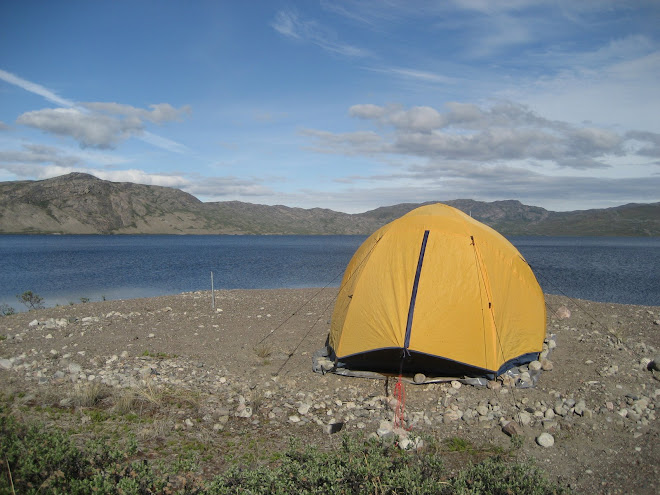
summer home
ventifacts still with ice: march 2008

circles of time
ventifact rock

scuptures of weather
headwaters of the watson river

this is not a moulin
glacial edge

spring calving
rhododendron, Laponica

a bonsai effect in the wild
Russel's glacier

water, cave, serac
Dye II

me and Steve and Raven
sled dogs

happy quick
wish you were here

chickweed

arctic harebells

edible, taste mildly nutty
Denis with "oil" and "failing"
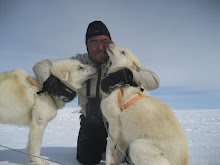
"it is a happy life"
Lunch break

wish you were here with us!
"Main Street" Kangerlussuaq

looking north from the bridge, KISS bldg. is red.
Watson River Gorge Bridge

watch as the level ct.s to rise over this season!
sled crossing

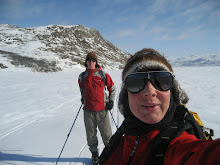
sking across lake furgusen
last winter's musk ox hunt

heads awaiting further processing
Raven's food put in

Hey! they've got fig newmans!
sunset over the Watson r.

sunday bike ride west
