John Muir stabbed one of his eyeballs with an awl. He was an avid inventor who, it is said, worked 24 hours around the clock tinkering with mechanical things. When he awoke from his bed rest after 2 weeks of blindness, and could see again, he went out into the world of nature to experience the delicate harmony of creation, change, flux, death and beauty.
I put down the book I was reading at the moment, describing John Muir, and decided, at 1130 at night to ride my bike up the hill to the lake where I have set up a tent for us to escape to, a summer home. The air was cold and the sky tumultuous. Dandelions are popping out all over the sides of the road. Far out on the fjord I could see dust being swept up into columns of silt. The ravens, who have been pushed out of town by all of the perching song birds, flew around the nests they have made in the hard sand cliffs conveniently located near the trash pile, which was smoldering from the last burning.
A fox ran ahead of me up the road leaving little prints in the sand.
When I got to the lake shore, the sky had just begun to touch down over Garnet Mt in the distance. The tent site is an elixir to the cement walls of the KISS building where all the communal noises of people living together commingle with the passing cars, airplane patterns, restless teenagers standing and un identified industrial sounds. At the lake I have a belonging sense. A time to look at Greenland without bus stops or computers or cars. I can allow the deep green of the hills and the storm sky blue gray of the water to color my marrow. I can try and become sympathetic to the possible meanings of the singing birds; at the very least I am becoming increasingly bewildered at the might and the passion of a bird tiny anatomy and Herculean soul.
Upon waking I noticed the first new Harebell, a tiny 4 petaled tissue paper of a thimble sized flower. Mist, as soft as a fresh woodland spider web, fell gently about my face. I forgot about my colleagues from work, the excited, celebratory researchers preparing boxes for their flight home.;even the noisy, midnight action of the local youths , in hooded sweatshirts and baggy jeans, leaning up against buildings, smoking cigarettes ,in the heart of Kangerlussuaq, had gone.
The bridge across the river allows for one to pass from the human world of daily necessities and hub-bub populace (even in a town of less than 600 ) into the ephemeral world of nature. It is a transport from a place of jet airlines and fork lifts and i-pods to a place of still fingerling and stoic sentries without names.
This is the thing I have been trying to grasp! The alluring aloofness, the odd magic and light. The weirdness of a felt feeling for the chance of a mastodon standing alone in the next broad valley. The drum beat of a people, whose ancestry is not so ancient yet.
Thursday, June 19, 2008


Tuesday, June 10, 2008
Kitchen Hill
On Sunday, I hiked to the top of Kitchen Hill. A strong breeze, smelling distinctly of wild flowers, did wonders to keep the mosquitoes away. At the summit, I met a duck; a male mallard who was so content with having his tail feathers in the air, and his bill beneath the water,that I was able to walk right up upon him without him noticing me.
After he was satisfied with his lunch, he promptly stood on one leg in very shallow water and began to preen his feathers nonchalantly. I was particularly struck by the always seemingly empty land and this one lone duck. We stood there together each in our place, just being quite for a long while. Without words or any mutual acknowledgment, we became friends.
When at last he took to wing, it was with more of a tender, unhurried, "adieu" than a frightened duck-like, quacking, rush! I was sad to see him go.
Far below, in the valley, the river has swelled. Parts of land that were not islands a day ago, are becoming so by the hour. Now, underneath the bridge, where the wide, quick waters are forced to be funneled, a falls is occurring. The froth of rapid turbulence has only just begun to hint at the force that will grow more powerful, indeed, become extremely violent soon(in another month, anything that were to be dropped into the river from the wooden bridge, a house hold appliance or a bus, a mobile home!, would have all of its atoms reconstructed in a matter of seconds).
Tonight I walked down to the channel of the Watson not yet full of water. I was accompanying two of the scientists that are working out of our building for the month. Adrianne and Nick. A geologist and a physicist. Adrianne, was searching for a ventifact, "smaller than torso size" but these rocks are massive or huge, and at the very least, are "two man rocks" that is, unable to be lifted without two men. Phenomenally voluptuous, bronzed with mineral veneers, sparkling with mica and feldspar, polished, pocketed and brushed, (as if by the hands of children entranced with a well loved chore)they refuse to be budged, but cannot remain untouched. Cupped and scalloped by wind and sand, these natural sculptures represent time and patterns of nature that not even a trained physicist and geologist can agree upon the formation of their chanced existence.
At long last, we found a few 15 pounders Adrianne would be able to stuff into her suitcases, and bring home with her to New York City.
In the distance, looking out the fjord, the first precipitous clouds in weeks, drew down a gray blur of rain between sky and the long far sea. Scudding, twilight -dirty -at midnight, cumulus, now move softly to the north. Passing over rock and pond and nestled ducks, moving underneath the always static dome of high latitude summer blue, a whisper of birds murmurs and even the standing musk ox, must now lay down for sleep.
After he was satisfied with his lunch, he promptly stood on one leg in very shallow water and began to preen his feathers nonchalantly. I was particularly struck by the always seemingly empty land and this one lone duck. We stood there together each in our place, just being quite for a long while. Without words or any mutual acknowledgment, we became friends.
When at last he took to wing, it was with more of a tender, unhurried, "adieu" than a frightened duck-like, quacking, rush! I was sad to see him go.
Far below, in the valley, the river has swelled. Parts of land that were not islands a day ago, are becoming so by the hour. Now, underneath the bridge, where the wide, quick waters are forced to be funneled, a falls is occurring. The froth of rapid turbulence has only just begun to hint at the force that will grow more powerful, indeed, become extremely violent soon(in another month, anything that were to be dropped into the river from the wooden bridge, a house hold appliance or a bus, a mobile home!, would have all of its atoms reconstructed in a matter of seconds).
Tonight I walked down to the channel of the Watson not yet full of water. I was accompanying two of the scientists that are working out of our building for the month. Adrianne and Nick. A geologist and a physicist. Adrianne, was searching for a ventifact, "smaller than torso size" but these rocks are massive or huge, and at the very least, are "two man rocks" that is, unable to be lifted without two men. Phenomenally voluptuous, bronzed with mineral veneers, sparkling with mica and feldspar, polished, pocketed and brushed, (as if by the hands of children entranced with a well loved chore)they refuse to be budged, but cannot remain untouched. Cupped and scalloped by wind and sand, these natural sculptures represent time and patterns of nature that not even a trained physicist and geologist can agree upon the formation of their chanced existence.
At long last, we found a few 15 pounders Adrianne would be able to stuff into her suitcases, and bring home with her to New York City.
In the distance, looking out the fjord, the first precipitous clouds in weeks, drew down a gray blur of rain between sky and the long far sea. Scudding, twilight -dirty -at midnight, cumulus, now move softly to the north. Passing over rock and pond and nestled ducks, moving underneath the always static dome of high latitude summer blue, a whisper of birds murmurs and even the standing musk ox, must now lay down for sleep.
Sunday, June 1, 2008
Moulin
A verticle shaft in a glacier, kept open by falling water, is a, moulin.I suppose the size of the shaft and the ammount of water drilling through the ice, though signifiagant, does not have defining prematers; a moulin could be a small stream and a small hole or it could be a river plunging down through a tunnel size cavern all the way to the bedrock.
Many of the reserchers that departed Kangerlussuaq almost a month ago, are now returning. We sit with some of them around the diner table, or stirke up long conversations in the hall. Sometimes, we are the first to see their most recent presentations. Jason Box, from the Byrd polar research Institue, a member of the, Extrmeme Ice Survey, a team captruing the speed of glaciers through time lapse photography, kept our attention piqued well up untill midnight last night. Through his dedication to capturing some of the most important glaciers in western Greenland, through the lenses of cameras mounted in fixed weatherproof boxes kept charged by solar panels, and his ease of communicating the drama of science to lay people, we learn perhaps too much, too quickly, and still, not enough.
I face dispare and also sadness as I watch a Niagra Falls ammount of water pour down into a hole "you could drive buses into" in the ice cap. Most likely it reaches the bedrock. There are theories that these moulins could be draining 2 miles down onto the basal layer of the island, over which the ice sheet rests, thus lubricating the bottom of the ice sheet causing it to flow faster than normal. Indeed, the time lapse photography compared with satleite telemetry and ground truthing, have proven that glaciers are traveling faster. Simple observations form tide line, show them to be retreating further.
But this is alarming, for now the global consortium of scientists are begining to feel cetainites. Certanties that not only may they have predicted the sea level rise to be less than it may actualy become, but that the climate too will change much more radicly and rapidly than first presumed. All nations across the globe need to agree to some sort of KYOTO protocol.
Still, all things are constanlty changing, and I am relieved from a circiling depression, like vultures, flying around a dieing beast, to a smiling wonder; a sudden, expanding, almost euphoric peace, for there is more knowledge being assinmliated throughout the world today then ever before in the history of the human race, and there is also, or so i bleive, more hope, more awarneess, more we can do.
By simply istening to and observing, any one of the dozens of reserachers we help to support, there comes though a presence of fearless comapssion. A final relinquishing of acceptance into the understanding of the total inter-connectedness of all beings; wether it be a glacier and a rock or a person and a honey bee.
As the earth exhales, we inhale. As we exhale, the earth inhales. As we learn to sit for longer and longer spans of time, in the quiet, silent, places, we learn how to watch a flower open, or an ice sheet move, or a landscape brighten with day. We learn that these places begin in our minds and expand into our hearts, then retract again into our mind; what does it mean to us, this flower this glacier, this cloud cover, clearing?
To some, they mean so much that they devout a life time of studying to just one tiny aspect of life. To the rest of us, we must smile that we are rleived of that duty for this time, so that we may embrace all that is around us, wherever we are, whatever we are doing, for like glaciers, we are moving faster and faster and yet, we are also, retreating.
Many of the reserchers that departed Kangerlussuaq almost a month ago, are now returning. We sit with some of them around the diner table, or stirke up long conversations in the hall. Sometimes, we are the first to see their most recent presentations. Jason Box, from the Byrd polar research Institue, a member of the, Extrmeme Ice Survey, a team captruing the speed of glaciers through time lapse photography, kept our attention piqued well up untill midnight last night. Through his dedication to capturing some of the most important glaciers in western Greenland, through the lenses of cameras mounted in fixed weatherproof boxes kept charged by solar panels, and his ease of communicating the drama of science to lay people, we learn perhaps too much, too quickly, and still, not enough.
I face dispare and also sadness as I watch a Niagra Falls ammount of water pour down into a hole "you could drive buses into" in the ice cap. Most likely it reaches the bedrock. There are theories that these moulins could be draining 2 miles down onto the basal layer of the island, over which the ice sheet rests, thus lubricating the bottom of the ice sheet causing it to flow faster than normal. Indeed, the time lapse photography compared with satleite telemetry and ground truthing, have proven that glaciers are traveling faster. Simple observations form tide line, show them to be retreating further.
But this is alarming, for now the global consortium of scientists are begining to feel cetainites. Certanties that not only may they have predicted the sea level rise to be less than it may actualy become, but that the climate too will change much more radicly and rapidly than first presumed. All nations across the globe need to agree to some sort of KYOTO protocol.
Still, all things are constanlty changing, and I am relieved from a circiling depression, like vultures, flying around a dieing beast, to a smiling wonder; a sudden, expanding, almost euphoric peace, for there is more knowledge being assinmliated throughout the world today then ever before in the history of the human race, and there is also, or so i bleive, more hope, more awarneess, more we can do.
By simply istening to and observing, any one of the dozens of reserachers we help to support, there comes though a presence of fearless comapssion. A final relinquishing of acceptance into the understanding of the total inter-connectedness of all beings; wether it be a glacier and a rock or a person and a honey bee.
As the earth exhales, we inhale. As we exhale, the earth inhales. As we learn to sit for longer and longer spans of time, in the quiet, silent, places, we learn how to watch a flower open, or an ice sheet move, or a landscape brighten with day. We learn that these places begin in our minds and expand into our hearts, then retract again into our mind; what does it mean to us, this flower this glacier, this cloud cover, clearing?
To some, they mean so much that they devout a life time of studying to just one tiny aspect of life. To the rest of us, we must smile that we are rleived of that duty for this time, so that we may embrace all that is around us, wherever we are, whatever we are doing, for like glaciers, we are moving faster and faster and yet, we are also, retreating.
Monday, May 26, 2008
road trip
On Saturday, Sparky loaded up the old Ford 4x4 and drove a group of us up to the edge of the ice cap. There is a long, sandy road that winds out of Kangerlussuaq along the Watson river to where the rock and heath end and the ice begins. A few miles before one parks, abruptly against the wall of seracs, the road turns into a jeep track. Muddied and rutted, steep and boggy, any attempt to drive out here is certainly not for the unordained - offroader; it is an experiment in the physics of torsional chassis dynamics and luck. We made it to the Russel's glacier just as the sun erupted from the overcast sky.
Covering the rock is a soil that is only about a foot deep. In this soil grows a variety of heaths and shrubs, flowers, sedges, grasses, lichens, moss, fungi, and the rhododendron, Lapponica. The tiny purple trusses of this northern most rhododendron are just beginning to open, some in full display, a bright, transparent purple flower smaller than the thumb.
All around in the air, birds chirped, flies buzzed, wind tickled the senses. Beside us, leaned the glacier's exposed, decaying, fragmented edge. Lacerated shards of blue so deep and clear and dull and scrathced and broken, yet sharp; threatening, beckoning.
From underneath roared water. It came from hollowed caves. It poured out from crevasses over quartz veined gneiss.It tumbled gray with silt, turquoise with light. We all stood waiting for a piece of the glacier to release itself to time aided by gravity, undermined by these waters, but none were ready to fall.
We hiked along the edge over barren rock towards a lake as silent and calm as a secret.
Steve and I had brought along our bikes. WE left the group of glaciologists and hydrologists that Sparky had brought out for the day, and headed back the 30 km to town. We passed a place in the road that seemed otherworldly. Rock and glacier, storm building sky, and an earth reveling in the glories of spring. Dust stirred through the air. No noise but the wind, creaking ice. Cairns built long ago, rumored burial grounds, lakes resistive to breezes, reflecting stone and cloud and blue and flashes of the sun.
Along the way we met a pair of travelers also out on bikes. A man an women. She from Denmark, he from Kurdistan. He had been rented the most pitiful bike I had ever seen go so far away from any help. The rim had been split, the rubber on the tire was lacerated and cut and broken down by UV rays. The tube had been punctured and they had no repair kit.
Luckily we had our bike tools and tube patches. We also had a first aid kit. The man with the flat had some string. I used 2 steri strips to hold the tape inside the rim together to keep the spoke screw heads from poking the tube. Steve patched the tire. WE cut strips from a felt cloth to line the inside of the tire, further protecting the tube, then I lashed string around the worst of the tire to give it new tread. I had taken 2 bike pumps for some readon this day, so we could afford to lend them one.
Later that night, back in Kangerlussuaq, they returned the pump to us. They had been able to ride out the whole way!
Covering the rock is a soil that is only about a foot deep. In this soil grows a variety of heaths and shrubs, flowers, sedges, grasses, lichens, moss, fungi, and the rhododendron, Lapponica. The tiny purple trusses of this northern most rhododendron are just beginning to open, some in full display, a bright, transparent purple flower smaller than the thumb.
All around in the air, birds chirped, flies buzzed, wind tickled the senses. Beside us, leaned the glacier's exposed, decaying, fragmented edge. Lacerated shards of blue so deep and clear and dull and scrathced and broken, yet sharp; threatening, beckoning.
From underneath roared water. It came from hollowed caves. It poured out from crevasses over quartz veined gneiss.It tumbled gray with silt, turquoise with light. We all stood waiting for a piece of the glacier to release itself to time aided by gravity, undermined by these waters, but none were ready to fall.
We hiked along the edge over barren rock towards a lake as silent and calm as a secret.
Steve and I had brought along our bikes. WE left the group of glaciologists and hydrologists that Sparky had brought out for the day, and headed back the 30 km to town. We passed a place in the road that seemed otherworldly. Rock and glacier, storm building sky, and an earth reveling in the glories of spring. Dust stirred through the air. No noise but the wind, creaking ice. Cairns built long ago, rumored burial grounds, lakes resistive to breezes, reflecting stone and cloud and blue and flashes of the sun.
Along the way we met a pair of travelers also out on bikes. A man an women. She from Denmark, he from Kurdistan. He had been rented the most pitiful bike I had ever seen go so far away from any help. The rim had been split, the rubber on the tire was lacerated and cut and broken down by UV rays. The tube had been punctured and they had no repair kit.
Luckily we had our bike tools and tube patches. We also had a first aid kit. The man with the flat had some string. I used 2 steri strips to hold the tape inside the rim together to keep the spoke screw heads from poking the tube. Steve patched the tire. WE cut strips from a felt cloth to line the inside of the tire, further protecting the tube, then I lashed string around the worst of the tire to give it new tread. I had taken 2 bike pumps for some readon this day, so we could afford to lend them one.
Later that night, back in Kangerlussuaq, they returned the pump to us. They had been able to ride out the whole way!
Subscribe to:
Posts (Atom)
Kangerlussuaq's golf club house

should we wait for the musk ox to play through?
dwarf fireweed

Greenlandic natl. flower
Lake Ferguson site
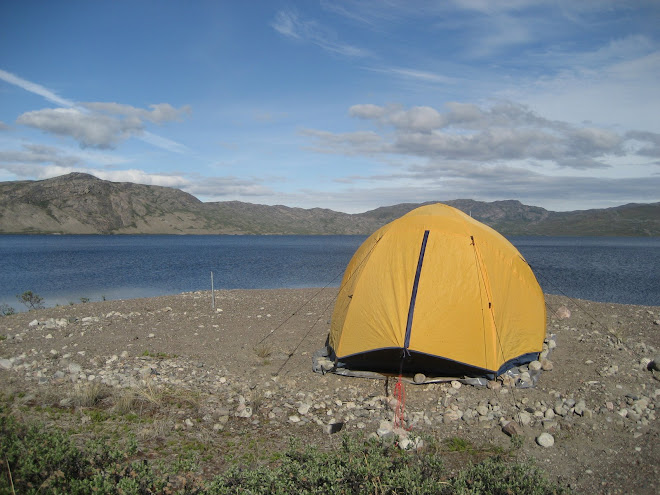
summer home
ventifacts still with ice: march 2008

circles of time
ventifact rock

scuptures of weather
headwaters of the watson river

this is not a moulin
glacial edge

spring calving
rhododendron, Laponica

a bonsai effect in the wild
Russel's glacier

water, cave, serac
Dye II

me and Steve and Raven
sled dogs

happy quick
wish you were here

chickweed

arctic harebells

edible, taste mildly nutty
Denis with "oil" and "failing"
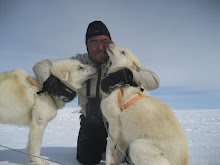
"it is a happy life"
Lunch break

wish you were here with us!
"Main Street" Kangerlussuaq

looking north from the bridge, KISS bldg. is red.
Watson River Gorge Bridge

watch as the level ct.s to rise over this season!
sled crossing

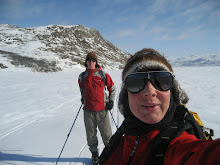
sking across lake furgusen
last winter's musk ox hunt

heads awaiting further processing
Raven's food put in

Hey! they've got fig newmans!
sunset over the Watson r.

sunday bike ride west
