Skrive blok, in Danish means, "witting pad". This could describe any blog, but since mine originally began as a means to write about Steve and I working in Greenland, It has since morphed into being about me, writing about being. Whether we are here or there, skiing or growing food or making some-things out of no-things, this is my humble attempt at being a writer. An exercise for my mind. A bunch or words. A Skrive Blok.

Wednesday, December 2, 2009

Part-way

Steve has written from the traverse: things are "boring" and for that he "is glad". Every night they shut down around 7:30 pm. After fueling the equipment for the next day and shoveling snow into the melter, for water, they enjoy each others company by warming a frozen, pre-made meal. Every morning they begin rolling before 8 a.m.. Steve eats as healthfully as he is able to; instant oatmeal packets for breakfast, left overs for lunch. In his tractor he stretches, listens to Danish lessons and does isometric exercises with a large rubber band. The convoy is now almost half way to the South Pole- having covered almost 500 miles out of the one thousand (and some odd change) they still have ahead. Steve seems to be happy or at least, has maintained his sense of humor. We miss each other much more than usual. Normally the one of us that has gone away to work misses the other but the other is then home with "the cat" living the life of a millionaire. This time we are both in the Antarctic, that is, we are both away from home and working; but while I remain behind here, in McMurdo, on Ross Island, Steve is "crossing the ocean of white"- if you will- "sailing to the Pole".

Because nobody thinks to ask about what they could never imagine life in Antarctica to be like, the things that are weird are worth mentioning: a person, walking out from a building dressed in a huge red parka eating a banana, mud puddles, getting mail order catalogs from the post office which we don't even get at home, fashionably dressed people attending thanksgiving diner in Manhattan styles; fur ruffs, dresses, suits and ties. A piper played his bag pipes- kilt and all.

An ER doc gave a disturbingly frank lecture- complete with cadaver and not yet cadaver (but looking like soon to be a cadaver) slides form the ER rooms he has served in over in Iraq. It was certainly one of those, drives the point home - types of lectures in which you walk away feeling a bit sorry for yourself that you're NOT being shot at because everyone else in the world seems to be being shot at. Then the reality strikes you and an overwhelming feeling of thankfulness swells up from inside; our life is pretty darn simple, pretty darn fantastic-and we are getting paid. It irks the be-jesus out of me to hear people complaining about things. They whine about the corporation, having their liberties taken away, or how the food doesn't suit them or they mumble non-stop about their jobs. Some simply prefer to stand around pumping at the bellows of a constant topic particularly favorable among the dramatists: chaos and dysfunction, all as if this were a society taken over by a de facto governance and not a contractual six month job one (eagerly) volunteered for.

Out of the hundreds of people down here , less than 2 dozen attended the Doctor's slide show on Iraq. I would have thought that more people were interested in hearing the story right from the horse's mouth. This Dr. (who has three children and a wife) even admitted to disliking the former president, was not shy about harboring disgust over all wars, shed tears during a recount of a particular death he witnessed in the OR and has been compassionate enough to send many many Iraqis out of Iraq to the States or to Germany for the care they had to have in order to survive.

I went up afterwards and shook his hand thanking him for the lives he has saved, for the efforts he has made spreading "light and love" as he himself exclaimed- where there has before been so much "darkness and hate".

These are the things that make this place so interesting-you never know who you are going to meet or what new idea will enter your mind. Being quite mercurial myself, I have recently taken to drawing out flow charts to better map my ideas; typically spawn from a book or an inspiring interaction, I leap into other worlds, dreaming. It is fascinating- if not in the least bit- grounding, to bring new awareness to the origins of these thoughts. Looking back over some of the charting, I can see patterns and may even be able to predict what reading a certain book might conjure up in me (currently I am reading a post doc thesis comparing aboriginal law and home-land rule in Greenland, and Nunavut. Naturally now, for instance, I want to become a lawyer for the Inuit of Greenland).

Nobody said that those of us who wander to these far flung fringes of the world are not a little bit different.

Work: fixing small lawn mower type engines that drive centrifugal diesel pumps, or peristaltic water pumps, nozzles that fuel as well as de-fuel military aircraft, gate valves, 6 inch hose fittings, large filter vessels housing four foot long fuel filters and miscellaneous broken other things: driver drill chucks, rotary hand pumps and bikes.
Food: we have been eating tons of fresh fruit and veggies this season: blood oranges and kiwis from New Zealand, cherry tomatoes and raw carrots. Why yesterday morning, during our safety meeting, someone passed around real blueberries and raspberries!
Events: there was a mild mannered game of touch rugby played down in the snow on the sea ice this past Sunday afternoon. I have volunteered to weld up a cribbage tournament trophy. The open water is 15 miles out. The barber is busy.

Sunday, November 22, 2009

Leave Taking

The South Pole Traverse, from here on out referred to officially as, SPoT- departed the local area on Friday morning at 1100 hours. The team consists of nine members: Terry Billings- leader, Steve Zellerhoff-equipment operator, Kristy Carnie-equipment operator, Dave weimer-equipment operator, Rob - equipment operator, Wayne Lundeberg-mechanic, Tom- mechanic, Jason-mechanic and Gallen-mountaineer and Ground Penetrating Radar (GPR) operator. As Steve commented later in his email, they left to, "absolutely no fan fare". In fact, most of the community of a little over one thousand people are still not sure whether or not the traverse has left or turned around or is surprised to hear that they had not yet made it back. Suffice to say, although we are living in a technological age of instant messaging, here on the ground- the big chiefs of this remote science station felt it wasn't all that necessary mentioning their departure. Nine people driving tractors to the south pole; what of it? Its been done before. I should mention then that they are pulling sleds equipped with yacht like living quarters, a machine shop, a generator module with a snow melter and almost 90,000 gallons of diesel fuel stored in bladders of 3000 gallons each all the way to the South Pole! Picture this: in front of the whole convoy tracks s a bright red Pisten Bulley (a ski area groomer). It is equipped with a boom extending out in front of it- much like a bow sprit- on which is affixed the ground penetrating radar. As Gallen drives across the ice shelf he is also reading the radar screen imaging looking for anything suggestive of a crevasse. The most heavily cravassed area, respectfully known as the Shear Zone-was crossed safely yesterday. The Shear Zone is worked for weeks in preparation of the traverse by first locating crevasses large enough to swallow tractors, blasting them with dynamite and then back filling them with snow pushed by D8-Caterpillar bulldozers. Crevasses occur here because the unyielding continental bedrock is resisting the hummocking roll of force created by the pressure of the constantly moving ice shelf. From the other side of the Shear Zone the route follows the path of least cravassed territory proven by satellite imagery, the GPR imaging and ground proofing of the six past traverses. The rules of glaciology and the known lay of the terrain being crossed have proven this to be the safest route to follow. Steve reported last night that they made camp in a white place surrounded by white and was surprised to learn that this was surprising to him. He called his revelation, "interesting". It was his turn to heat up diner. Diner is the only meal they eat that has been prepared for them and served hot. These meals were cooked ahead of time by a catering firm in Christchurch and come as large frozen entrees. I imagine family sized lasagnas. Last nights meal was pub cod, mashed potatoes and cauliflower- "white food". For breakfast Steve indulges himself with packets of instant oatmeal which he enjoys with the soy milk he brought along from the store in McMurdo. Lunches are cold cuts, PB&J or tuna on, what I hear- is lovely bread- baked in New Zealand. They do have the ability to use the Internet, though as you can imagine-as it would be at sea, the service is slow and quiet limited. There is one computer for nine people. I went out to see Steve off on Friday and got a tour. I saw his tractor which he has rigged up with various anchors for an isometric rubber band (the kind a Physical therapist would give you) which he plans to use to quell boredom and keep in shape. I saw his bunk which is in the main living module which shares the kitchen, the computer space, and some more bunks on the opposite end. In Steve's quarters, which he has labeled, "us" are four bunks. In the foreword berthing which he labeled, "Them" are more bunks. An additional bunk house unit separate from these quarters also exists and is labeled H2. I don't know what that means.
Meanwhile in McMurdo I have been informed that I will be getting a roommate. Her name is Jill and she is a scientist. She claims to be tidy, smoke free and incapable of snoring. She should be leaving about the time Steve returns...sometime in January. A blizzard came through last night. We have all been anticipating our first holiday in three months: a 2 day weekend in celebration of Turkey day (which I think should be re-named Pumpkin pie day). However the man in charge of calling the shots out on the ice runway- which will soon need to be moved out onto the ice shelf before the annual sea ice break up- has announced for us all to stand by to stand by which means, in his parlance: "y'all might have to work over the Holiday weekend". Though this has us all in a dismal mood we have been promised that we would get our 2 days of freedom the following weekend and, would still be served thanksgiving day meal someday near thanksgiving.
My guess is that in less than three weeks, if these strong southerlies keep up, the salt water will be tossing waves ashore here and we might even get to see some of the world's most coveted wildlife: penguins!
If anyone has questions for Steve, post them in the comments. I will try my darnedest to get them relayed out to him and reply to you through this blog which I now have time for and am happy to be writing again.
The cheese here (flown in from Christchurch)is fantastic and money is going into our bank account. Malcolm reports that Jamie and Marcus are better "house-guests" then Steve and I and has yet to shed a tear in our absence. Maybe we should get a dog.

Saturday, September 12, 2009

McMurdo Station

The use of the word skua has been derived from the noun, skua gull, a notorious Antarctic scavenging sea bird. Skua, as a McMurdo Station colloquialism has become a verb; the act of people searching for things other people no longer want, skuaing. There is even a building devoted to skua. It is a goodwill bin sorting room lacking organization, cleanliness or price tags.
In the heated, modular, Korean war era T-5 building known as the, skua barn I look for whatever just for interest. There is an assortment of Westerns, sci fi and romance novels, a feather boa, a snoopy sno cone maker, a nappy yellow bean bag, silk flowers, worn out clothes, a curling iron, dirty coffee mugs, text books and plastic toys. I collected a wooden dradle, a three inch tall plastic tree stump- complete with a wedge notched in it and a bag of balsam needles from the Maine woods.
The act or art of skuaing offers visual and creative stimulation, a short respite from the 60 hour work week.
The view out of our third story window is of the other brown sided building full of brown creaky wardrobes and brown spongy beds. The food is good and someone else does our dishes after every single meal.
Today is Sunday and so we can all relax. I took a hike up Observation hill, this morning, still, in the soft glow of a magma hot sun rise (plus 5 degrees F). We ate fresh baked bagels and fruit and drank our tea, idly chatting with friends.
A glaciologist wears a blue crocheted octopus hat with googly eyes. A man at breakfast dressed as a penguin. One man plays the ukulele in the stairwell at night after work, another friend plays the fiddle. Dawn occurs at 6 am and dusk comes 12 hours later. The colors are tropical and almost give off a false sense of being warm. There are afternoons when the sky is alive with nacreous clouds, swirling cirrus wisps pf electric mother of pearl unique only to these high latitudes.
One of the dish washers was formerly a graphic artist for Victoria's secret.
This place can feel as strange as science fiction with the giant geodesic communication domes perched like static moons on the hills-especially when the temperature drops to almost 100 below zero Fahrenheit with wind chill. But beneath the luminous lens of a storm cloud formed by Mt Erebus, there are cigarette buts tossed in the snow and ford trucks driving around and the droning noise from the power plant. People are busy all the time here either putting radios on penguins and cameras on seals or baking 20 loaves of bread or fixing things with parts wrapped in cosmaline bearing a hand typed part number on yellowed paper or with duct tape that lost its stick sometime shorty after the end of the cold war.

Thursday, April 30, 2009

Facts

This picture shows me standing in the middle of the ski way at summit station on the Greenland ice cap. The reason it is called a ski way rather than a runway is obvious if you really think a little about physics and airplanes, verses snow and cement. You can see the flags vanishing to a point in the distance. The point in the distance is less than 3 miles behind me. This picture was shot on a calm day in the fall. I would say the ambient temperature was around -20 F, or even warmer, because I am not wearing a neck gaiter or my big- issued, down parka. The down parkas we are issued, weigh about 12 pounds new and cost over 800 dollars. I have a radio in my back pack along with a thermos of hot water, snickers bars (which have already frozen into jaw breakers). Steve took the picture, so someone is with me. Further more, other people know that Steve and I had set off for a hike.
Mexico covers 756,006 square miles of land. The ice cap of Greenland- covering five sixths of the worlds largest island, is roughly the same size as Mexico; since Greenland's total land mass is 840, 003 square miles.
Imagine yourself now being lost on this ice cap in a blizzard. You cannot think about the blizzards you have seen in Michigan or Connecticut or Maine, because in fimiliar contexts, your imagination will be biased: you might be traveling home from Christmas caroling with a church group, you might be out on the side walk shoveling- everything is still near and the lights can be seen, motors heard, your chances of dieing are nil. It would be better for you to try and imagine being lost at sea in a fog in the arctic in a skiff that has run out of gas. You didn't tell anyone where you were going-which doesn't matter since you are not where you were going. You are lost. You don't have a radio or a flare or a tent or even an issued parka.
The temperature is well below freezing. It is minus 35 F. The wind is blowing a gale. The only navigational aids are flags which have long ago become obscured in the frost and wind and blowing snow. There is nothing else to delineate your landscape. Remember you are at sea, far off shore, or in the middle of the flattest part of the storming Sahara; you are on top of the world,s largest ice cap, alone. Your chances of dieing now, are superb.
On the 16Th of this month, unbeknownst to Steve, or anyone else up at camp, two of the camp staff went for a joy ride on snow machines. Maybe they even had had something to drink. They went out into fresh winds- not yet gale force. They followed the bright black flags down to the end of the ski way ducking behind the wind screens, exhilerated and then, ideling the engines at the far end, they were overcome with the immidate knowledge that they had better go back. But they lost one another and themselves. The mechanic stopped when he knew he was lost and dug a hole with the shovel that had, by luck, been on the back of his machine. After 16 hours living like a sled dog on the trail, he dug himslef out, started up his machine and went back to camp where he was shocked to learn that his friend was not home.The other man, the man now in the burn center of the University of California, at Davis, kept going. In fact, his machine, when found 3 days later, was far away from the ski way; you will have to forgive me for not being able to cite the exact distance, but roughly 13 miles, and was run out of gas. As soon as it was known that a person was missing out on the ice cap, Steve launched a search and rescue mission involving every resource they had. For three days he was beside the phone and radio maintianing communcation links; catching only short naps, he continued with the neseccary camp duties required of him while commiserating with and encouraging the three remaining crew to remain hopeful.
The only news story I could find relating this incident was published by Fox news, who repeated the National Science Foundation's blurb. Giving no names, other than, NASA, the NSF, the Royal Danish Air force, "people in Kangerlussuaq", and, the 109Th Air National Guard, I found it outrageous that the photo they slectected, encaptioned, "Ariel view of the ice cap" was a floating ice berg. If you watch this crap, shame on you for being so unintelligent-you are probably still trying to figure out what the differences are between a runway, and a ski way.
After 60 hours, the lost man was found. He was spotted by a colluege of ours, a man of both Danish and Inuit ancestry. A man named, Basse. Basse and I spoke on the phone a few days after the lost man was found. Basses described to me what he was looking for as being what is known as a body drift. He happened to be driving a tracked snow cat when he noticed a "speck on the windhseild -but it wasn't a speck". He kept his eyes on the mark and as they neared the body drift, for after 50 hours lost man was presumed to be dead lost man, the "body drift", stood up! He was 12 miles from camp.
The damage done, was mostly to his hands. Leather, thinsualte lined mittens with no cuffs had slid down below the wrist bone and were no longer able to be pulled up, once the hunting stage of cold (as low as minus 50 with wind chill) had set into the fingers. After this, ischemia occurs, which is loss of blood flow. Next, cells begin to die. When his clothes were cut off of him, inside the warmth of the station, his mittens and socks were not among the articles removed. Ice crystals held them to flesh. Lost man, thought to be dead man, now found man, was medivaced first, to the hospital in Nuuk, (the capitol of Greenland) and later, to the UC Davis burn center near his family. Last I heard, he had gone in for a surgical procedure; a final analysis of the vascular and cellular damage sustained before what we are all presuming to be amputations of both hands from mid wrist down.
Over 4000 years ago, the Inuit migrated to Greenland form North America. They developed senses which enabled them to survive sea ice travel, long dark winters subsisting off of raw meat, isolation- stymied only by mythological visitors: the northern lights, understood to be the spirits of their ancestors, senses that were accute and as critical as instincts. Basse and I have spoken a few times about the knowelged of his people's past and the responsibilities of being aware still, divided by intersecting aspects of modern times. I listened to him well. As soon as I heard that he had gone up to the ice cap, a place no ancient Greenlandic person ever would have gone-for there is nothing there to offer the living, other than death; I knew he would find the man he was looking for. I dint know that he would find him alive.
To give some perspective on how the people of Greenland view this story, I could find no mention of it in their news. It is no where as near as extraordinairy as recent findings of methane gas or integrating schools with non native speakers. To them, it must be not so much a moment's story- now told between family over cell phone or via email, as it is a permission slip into recollection; an ability to beleive again in a past now thought to be more incredible than real. Life goes on. Back at home In Kangerlussuaq, on the west coast of Greenland, Basse sips his coffee, plays with his kids, surfs the hundreds of thousands of satellite channels on his wide screen TV and gazes out at the changing fjord: it is begining to melt, slowly. He might even be thinking about trying again to grow a lawn this summer. Or maybe he is thining about a speck, on a vast, white, seeminlgy endless surface of 40 below where someone from the spirit world lingered- just long enough, to help show a lost, white man, his blundering way home.

Kangerlussuaq's golf club house

Kangerlussuaq's golf club house
should we wait for the musk ox to play through?

dwarf fireweed

dwarf fireweed
Greenlandic natl. flower

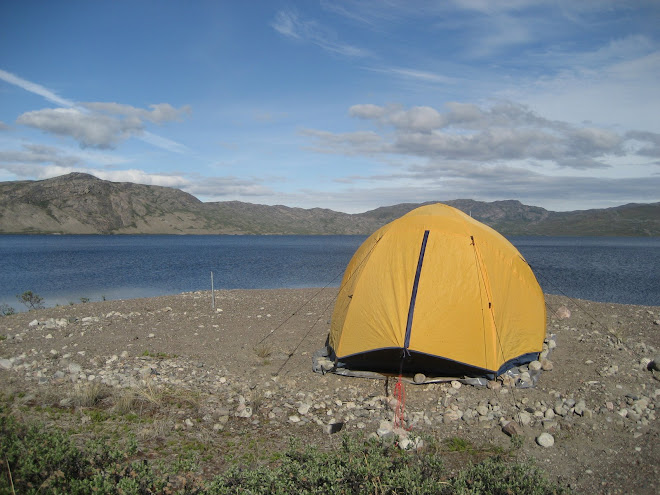
Lake Ferguson site

Lake Ferguson site
summer home

ventifacts still with ice: march 2008

ventifacts still with ice: march 2008
circles of time

ventifact rock

ventifact rock
scuptures of weather

headwaters of the watson river

headwaters of the watson river
this is not a moulin

glacial edge

glacial edge
spring calving

rhododendron, Laponica

rhododendron, Laponica
a bonsai effect in the wild

Russel's glacier

Russel's glacier
water, cave, serac

Dye II

Dye II
me and Steve and Raven

sled dogs

sled dogs
happy quick
"Beware the fallacies into which undisciplined thinkers most easily fall, they are the real distorting prisims of human nature".
Francis bacon

wish you were here

wish you were here

chickweed

chickweed

arctic harebells

arctic harebells
edible, taste mildly nutty

Denis with "oil" and "failing"

Denis with "oil" and "failing"
"it is a happy life"

Lunch break

Lunch break
wish you were here with us!

"Main Street" Kangerlussuaq

"Main Street" Kangerlussuaq
looking north from the bridge, KISS bldg. is red.

Watson River Gorge Bridge

Watson River Gorge Bridge
watch as the level ct.s to rise over this season!

sled crossing

sled crossing

sking across lake furgusen

sking across lake furgusen

last winter's musk ox hunt

last winter's musk ox hunt
heads awaiting further processing

Raven's food put in

Raven's food put in
Hey! they've got fig newmans!

sunset over the Watson r.

sunset over the Watson r.

sunday bike ride west

sunday bike ride west